Wedding Hotel Room Blocks in Canada: Contract and Booking Guide
Published: August 10, 2026 Last reviewed: August 10, 2026.
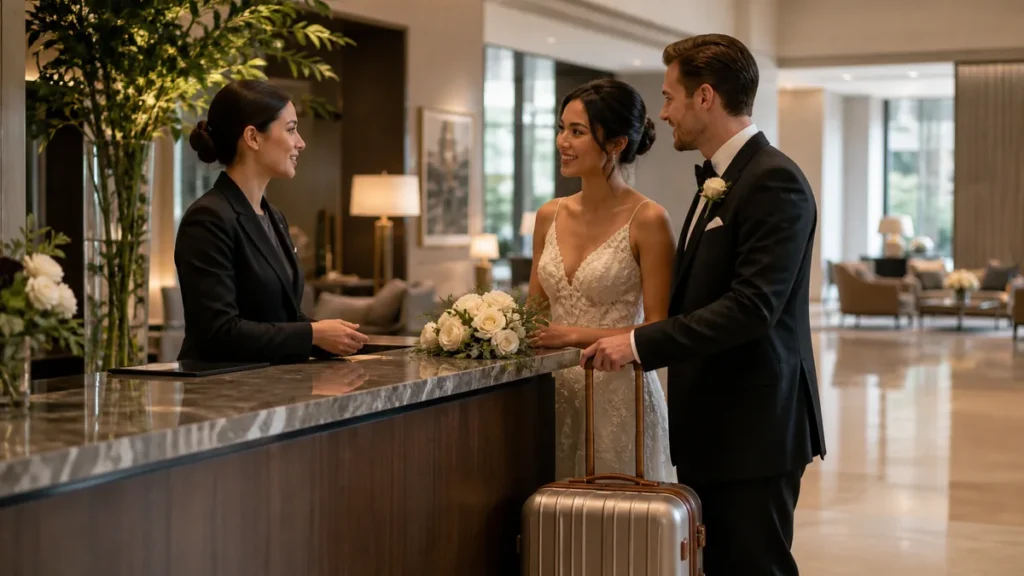
A wedding hotel room block is a set of rooms held for your guests under a group booking link, code or reservation process. It can make a multi-day celebration easier to navigate, especially when people are travelling, but it is not automatically a bargain and it is not always risk-free. The important decision is not simply how many rooms to request; it is whether the agreement leaves you financially responsible for rooms your guests do not reserve.
Hotel policies vary by property, date and local demand. For example, Delta Hotels Thunder Bay advertises a special rate with a block of 10 or more rooms, while Choice Hotels Canada says individual hotels set their own deposit policies. Treat every offer as property-specific, read the written terms and choose a block your guest list can realistically support.
When a wedding hotel room block is worth arranging
A block is most useful when a meaningful share of the guest list will stay overnight: people travelling from another city, a wedding party getting ready nearby, guests attending a rehearsal dinner or brunch, or guests who would otherwise need late-night transportation. Keeping a core group at one property can simplify shuttle pickup points, welcome-bag delivery and day-after plans.
It is less essential for a local daytime wedding with few overnight guests and plentiful accommodation nearby. In that situation, a short list of nearby hotels, with clear transport and parking information, may serve guests better than a contract. Do not create a block solely because it seems like standard wedding etiquette.
Start by estimating room nights, not people. A couple staying Friday and Saturday represents two room nights; a family sharing one room is still one room per night. Ask likely travellers whether they expect to stay, which nights they need and whether they will share. Use that information to decide whether to request a small courtesy block, a larger contracted block or no block at all.
- A block is usually helpful when guests are travelling, the venue is remote, or the celebration spans more than one day.
- A block may be unnecessary when most guests live locally and can choose among many nearby hotels.
- Offer a property at a practical price point and distance before focusing on perks for the couple.
Courtesy blocks and guaranteed blocks are not the same
A courtesy block generally holds a limited number of rooms for a defined period, then releases any unreserved rooms. The key feature is that the hotel does not require the couple to guarantee a minimum amount of room revenue. Ask the sales representative to confirm that there is no attrition charge, no deposit exposure and no obligation to pay for unused rooms; do not assume the word “courtesy” settles every detail.
A guaranteed or contracted block typically reserves more inventory or offers different terms in exchange for a financial commitment. The contract may require the group to achieve a stated number of room nights or a percentage of room revenue. If the group does not meet that commitment, the hotel may charge the contracting party for the shortfall. Hilton specifically advises event planners to understand guarantee, cancellation and attrition policies in the contract.
Neither type guarantees that extra rooms will be available later. A booking link can sell out, and rooms released after a cutoff date can be booked by the public. If your wedding is on a high-demand weekend, keeping the first block modest and asking how additions will be handled is often more useful than signing for a large number of rooms you cannot confidently fill.
- Courtesy block: confirm the release date, room types, rate and that unused rooms create no charge to you.
- Guaranteed block: identify the exact commitment, the calculation method and who is liable for a shortfall.
- Avoid relying on verbal descriptions; the signed agreement controls.
Size the block from likely room nights, not the invitation count
Make a simple accommodation list before asking for quotes. Mark each household as local, likely overnight, possible overnight or unknown. Then note whether they need one night or several and whether they may share a room. Your wedding party, immediate family and guests travelling a long distance are usually the most reliable starting group; a broad invitation count is not.
Build in only a modest margin for people who have clearly indicated they expect to stay. If you need more rooms, ask whether the hotel will add them at the group rate as bookings come in, subject to availability. If the hotel will not add rooms, decide whether the benefit of locking in inventory is worth the stated financial risk.
Hotel thresholds are not uniform. Choice Hotels Canada says most hotels prefer groups of 10 or more rooms, and Delta Hotels Thunder Bay advertises a special rate for a block of 10 or more rooms. Those are examples of individual brand or property practices, not a Canadian rule. Ask each hotel for its minimum, maximum, dates and room-type allocation.
- Count room nights by date: Friday, Saturday and Sunday demand may differ.
- Do not count guests who have not indicated they will travel as committed rooms.
- Request a mix of bed types only if the hotel confirms the mix can be held.
Compare offers on the total stay, not just the group rate
Request comparable written proposals from two or three properties within a realistic distance of the venue. Ask for the nightly group rate by room type, the dates covered, mandatory fees, taxes, parking, breakfast, internet, resort or destination charges where applicable, and the cancellation terms each individual guest will face. A lower base rate can be less helpful if the location requires expensive transportation or if required charges materially increase the stay.
Check the booking experience. Fairmont Le Château Frontenac states that guests can reserve through a customized event booking website for a contracted block and that the couple can receive guest-list updates. Other properties may use a booking code, a central reservations line or an email process. Choose a method your guests can actually use and ask who will fix booking errors.
Also compare accessibility and logistics: accessible room availability, step-free route from parking or drop-off, elevator access, accessible washrooms in common areas, pet policies, child accommodation, luggage storage, check-in timing, and whether a shuttle can safely load. These details matter more than a nominal group discount when guests have different needs.
- Ask for an all-in estimate for a typical room night, with all mandatory charges identified.
- Confirm whether group guests can book the nights before and after the wedding at the same rate.
- Ask whether loyalty points, accessible room requests and early or late check-in requests are handled through the same booking process.
What to check in a wedding hotel block contract
Read the room-block agreement separately from the reception or catering agreement, even when the same hotel supplies both. Confirm the contracted arrival and departure dates, the number of rooms per night, room categories, group rate, taxes and any mandatory fees. If a complimentary room, suite upgrade, late checkout or welcome-bag handling matters to you, have it written into the agreement rather than treating it as an expectation.
The financial section deserves the slowest read. Find the attrition or performance clause, the percentage or revenue commitment, the date on which the hotel measures pickup, what happens if rooms are resold, whether cancellation charges are separate from attrition, and the payment deadline. Ask the sales contact to show a worked example using your proposed block. If a term remains unclear, get a written explanation before signing.
Check how bookings outside the official link are treated. A guest may reserve directly, use a corporate rate or book a different room category. Ask whether the hotel can associate eligible reservations with your block, what information it needs, and when that must be done. Never promise guests that a rate will be the lowest available unless the contract actually says so.
- Room count and room types for each night.
- Group rate, taxes and mandatory fees.
- Cutoff date and the time zone that applies.
- Attrition, deposit, cancellation and payment terms.
- Process for adding rooms, releasing rooms and crediting direct bookings.
- Named contact and response process for guest booking issues.
Set a booking timeline guests can follow
Once you have a signed agreement and a working booking link or code, publish the hotel information on your wedding website and share it with travellers early. Include the hotel name, address, booking link or phone instructions, group name or code, rate, dates covered, cutoff date, parking and transport notes. State plainly that guests reserve and pay for their own rooms unless you are hosting a specific room or night.
Send a reminder before the cutoff date, especially to guests who said they planned to travel. Keep the wording factual: rooms are available while the block lasts, and bookings after the cutoff are subject to the hotel’s availability and then-current terms. Do not pressure guests to stay at your chosen hotel; a block is an option, not an attendance requirement.
Track pickup using reports supplied by the hotel where available, but protect guest privacy. You need overall pickup information to manage the block and plan transportation, not a public list of who has or has not booked. If your hotel has a financial commitment, ask for periodic pickup reports early enough to make a permitted reduction or release request before the contract deadline.
- After signing: test the booking link or code yourself before sharing it.
- With invitations or travel details: give the rate, dates, cutoff and transport information.
- Two to three weeks before cutoff: send one concise reminder to likely travellers.
- After cutoff: confirm final pickup, shuttle numbers and any welcome-bag delivery plan.
Plan for Canadian travel and regional realities
Canada-wide wedding planning does not create one hotel-block rule. Hotel contract terms, local demand, taxes, parking arrangements and shuttle availability vary by property and community. A long-weekend wedding, a festival weekend, a university event, a major convention or a wedding in a small tourism market can change availability dramatically. Ask the hotel what other local demand is expected on your dates, then make your own decision from the offered terms.
For rural, mountain, island or winter weddings, accommodation and transportation should be planned together. Identify whether guests can safely travel between the hotel and venue after dark, where vehicles can park, whether a shuttle needs advance reservation and what the backup plan is for severe weather. Link those details to your wider weather plan rather than treating lodging as a standalone task.
In Québec, give guests the booking information in the language they will find easiest to use, and confirm the hotel’s preferred process for a bilingual guest list or welcome materials. In every province and territory, accessible rooms and connecting rooms are limited inventory: submit requests early, but make clear that room features are subject to the property’s confirmed availability.
- Check calendar conflicts and transport capacity before locking the block.
- Give guests a practical alternative if the primary hotel is full or unsuitable.
- Keep winter driving, ferry schedules and late-night transport in the same planning document as hotel details.
A low-risk decision framework
Choose a courtesy block when you want a convenient guest option but the number of room nights is uncertain. It is generally the clearest fit for couples with a mixed local and out-of-town guest list, provided the agreement truly has no unused-room liability. Ask whether the hotel can add rooms later at the same rate, but plan as if additions are not guaranteed.
Consider a guaranteed block only when you have strong room-night evidence, understand the shortfall calculation and are comfortable with the maximum financial exposure. It can make sense when most guests are travelling and a single hotel is central to the wedding weekend, but it should be a deliberate contract decision—not a default response to a sales proposal.
If neither option works, give guests a curated accommodation list instead. Include two or three areas or properties, approximate distance to the venue, parking or shuttle notes and a booking deadline for any transportation you are arranging. The goal is a workable stay for guests, not filling rooms for its own sake.
- Uncertain demand: request a true courtesy block or provide recommendations.
- Reliable demand and acceptable contract terms: evaluate a guaranteed block.
- Unfavourable terms: decline and give clear accommodation and transport guidance.
Continue planning
- wedding venue contract checklist
- wedding invitation timeline
- accessible wedding planning checklist
- Canadian wedding weather contingency plan
- Canada Wedding Directory
Frequently asked questions
Do you have to pay for a wedding hotel room block in Canada?
Not always. A courtesy block may release unused rooms without charging the couple, while a guaranteed block can make the contracting party responsible for a room-night or revenue shortfall. Confirm the deposit, attrition and cancellation clauses in writing for the specific property.
How many hotel rooms should I block for a wedding?
Base it on likely room nights from travellers, not the total number invited. Count each household’s expected nights and start with the guests who have confirmed they will need accommodation. Hotel minimums differ by property; Choice Hotels Canada notes that many hotels prefer groups of 10 or more rooms.
What is hotel attrition for a wedding?
Attrition is the contractual shortfall that can arise when a group does not meet its agreed room-night or room-revenue commitment. The method, deadlines and liability vary by contract. Ask the hotel for a written worked example before you sign.
Can guests book outside the hotel block and still count toward it?
Sometimes, but only if the hotel agrees and follows a stated process. Ask whether direct bookings, different room categories or bookings made with another rate can be associated with the block, what proof is required and by what deadline.
When should guests book rooms in a wedding block?
As soon as the booking link or code is live and the guest knows they need a room. The group rate usually has a cutoff date, after which unreserved rooms may be released and additional bookings depend on availability. Include that date in every travel message.
Should we reserve rooms at more than one hotel?
It can help when guests have very different budgets or the primary property has limited inventory, but it adds shuttle, communications and tracking complexity. Start with one practical primary option, then add a second only when it solves a clear guest need.
Sources and verification notes
These sources were reviewed on August 10, 2026. Requirements, prices and availability can change; confirm time-sensitive details directly.
- Plan an Event — Hilton
- Wedding Room Block at Delta Hotels Thunder Bay — Delta Hotels by Marriott
- Hotel Group Rates for Weddings — Choice Hotels Canada
- Weddings at Fairmont Le Château Frontenac — Fairmont Le Château Frontenac
Recent Ratings
-

Olivia Marie Events

Ontario » Barrie ()
-

Tamea Burd Photography
British Columbia » Vancouver (Wedding Photography)
-

the barn 1906
Ontario » Bradford (Farm Weddings)
-

M2S Photography

Alberta » Edmonton (Wedding Photography)
-

The Club at North Halton
Ontario » Halton Hills (Wedding Banquet Halls)
-

Monolith Photo
Ontario » Mississauga (Wedding Photography)
-

Rebecca Elizabeth Louise Photography
Ontario » Ottawa (Wedding Photography)
-

Aneta Elizabeth Photography
Ontario » Newmarket (Wedding Photography)
Popular Listings
-

Iconz
327 viewsQuebec » Montreal (Wedding Entertainer)
-

ShutterBrugs Photography
419 viewsOntario » Beamsville (Wedding Photography)
-

St Brigid’s Centre for the Arts
519 viewsOntario » Ottawa (Wedding Banquet Halls)
-

Adam See Photography
549 viewsOntario » Barrie (Wedding Photography)
-

Robin Radke Photography
476 viewsAlberta » Edmonton (Wedding Photography)
-

Love Forever Studio
450 viewsOntario » Richmond Hill (Wedding Photography)
-

Bethesda Karen Baptist Church ( The Little White Chapel )
554 viewsBritish Columbia » Chilliwack (Wedding Banquet Halls)
-

Blue Clover Paperie
530 viewsQuebec » Laval-Ouest (Wedding Invitations)