Wedding Fireworks in Canada: Permits, Operators and a Safe Venue Plan
Published: August 14, 2026 Last reviewed: August 14, 2026.
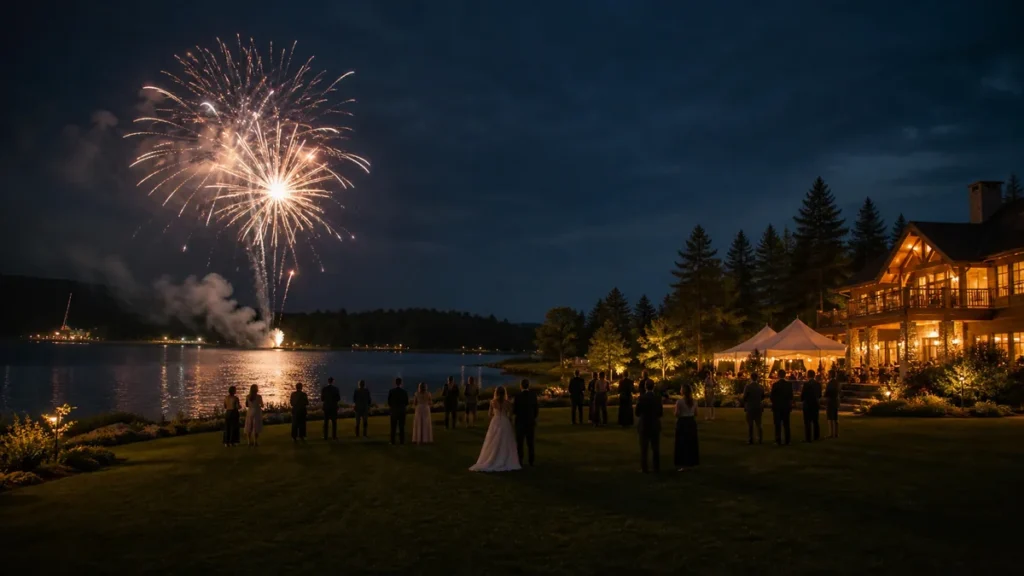
A fireworks finale can be possible at a Canadian wedding, but it is not a décor add-on to book after the venue. A professional display is a regulated activity that needs an appropriate site, a certified fireworks operator, written approval from the authority with jurisdiction, and the venue’s written agreement. Consumer fireworks, indoor effects and “cold spark” machines can follow different rules again.
Start the conversation before signing a venue contract or paying a fireworks supplier. The decisive question is not simply whether the venue says it “allows fireworks”; it is whether the proposed effect, property layout, local rules, insurance and wedding schedule can all work together on your date. This guide separates those decisions so you can get a clear yes, a workable alternative, or an early no before it becomes an expensive surprise.
First, identify the effect you actually want
Couples often use “fireworks” to mean several very different effects. That distinction matters because the operator qualification, approval process, site requirements and venue response can change with the product and setting. Ask the supplier to describe the exact product category and where it will be used, rather than relying on a mood-board image or a package name.
A display fireworks show is the outdoor aerial finale most people picture. Under the federal Explosives Regulations, a person organizing a fireworks display must ensure it is supervised by a display supervisor in charge, and the display requires a written plan and local-authority approval. It is not something a couple, DJ or venue employee should improvise from retail fireworks.
Consumer fireworks are lower-hazard retail products. Their permitted dates, locations and permit requirements are commonly controlled by municipal bylaws, so a private rural venue does not automatically make them permissible. Indoor special-effect pyrotechnics and pyrotechnic simulation devices, including some spark-producing machines, are another category that a fire authority or venue may require to be permitted.
A sparkler exit deserves the same early question. Even if an item seems quieter or smaller than aerial fireworks, it may be restricted by the venue, insurer, municipal rule or wildfire conditions. Obtain confirmation for the exact product and plan rather than treating “sparklers allowed” as a blanket approval.
- Outdoor aerial display: professional fireworks, firing area and fallout zone.
- Consumer fireworks: retail products subject to local restrictions and date limits.
- Indoor pyrotechnics or spark effects: may trigger fire-safety review and a separate permit.
- Handheld exit items: need venue and local-rule confirmation for the specific item.
A venue’s verbal yes is only the first approval
A venue controls its property, but it cannot waive a federal safety requirement or a municipal permit. Ask the venue for written approval that identifies the proposed date, time, product category, firing location, guest-viewing area and the professional supplier. Confirm whether the venue has previously hosted an approved display; that is useful context, but it does not transfer an earlier approval to your wedding.
The property’s physical constraints often decide the outcome. A legitimate display plan must account for the firing site, spectators, buildings, vehicles, overhead obstructions, neighbouring land and the area where debris could fall. A beautiful courtyard, golf course or waterfront view may still lack a workable exclusion area once guests, parked cars, tents, trees, nearby homes and wind direction are considered.
Check the contract before relying on a supplier’s quote. Look for restrictions on open flame and pyrotechnics, required certificates of insurance, indemnity obligations, preferred-vendor rules, curfews, sound limits, cleanup and the venue’s right to cancel for weather or safety. Use the questions in the [Canadian wedding venue contract checklist](https://canadaweddingguide.com/blog/wedding-venue-contract-checklist-canada/) to keep the approval and cancellation terms in writing.
- Request written venue consent, not an informal assurance.
- Ask whether neighbouring property access or consent may be needed.
- Confirm who supplies fire watch, security, cleanup and post-show inspection.
- Keep the display time compatible with the venue’s event-end and noise rules.
How Canadian rules vary by province and municipality
There is no single wedding-fireworks permit that applies across Canada. Federal explosives rules govern professional display safety and operator responsibilities, while provincial laws and municipal authorities can add restrictions or require the local approval that makes a specific event possible. The local fire department, fire prevention office or municipal permitting office is usually the practical starting point once you know the venue address.
Ontario provides a clear example of municipal variation: the Municipal Act authorizes municipalities to prohibit or regulate fireworks and to require permits for displays. A rule in one Ontario municipality should not be assumed to apply in the next one. In Mississauga, for example, professional display fireworks require a permit, while consumer fireworks have narrowly defined holiday windows and location restrictions.
British Columbia is also jurisdiction-sensitive. The B.C. Fireworks Act applies in municipalities that declare it applicable by bylaw and in designated rural areas; where it applies, the Act sets restrictions on selling, giving, firing or setting off fireworks and requires written permission from the local authority for a public display. Municipal bylaws can be more restrictive.
Treat provincial examples as a reminder to verify the venue’s exact municipality or regional district, not as a shortcut. If the venue sits near a boundary, is in an unincorporated area, is on a park property or has a waterfront component, ask the authority with jurisdiction to identify every approval that applies.
- Give the authority the exact venue address and proposed start and end time.
- Describe whether it is a professional display, consumer fireworks, indoor effect or simulated effect.
- Ask about current fire restrictions, permit lead times, fee schedules and inspection needs.
- Ask whether a park, conservation authority, airport, waterway or neighbour creates an additional approval step.
Hire the operator before you build the wedding timeline
For a professional display, your supplier should be able to explain who will be the display supervisor in charge and provide the relevant current fireworks operator certificate. The federal regulations require a written plan that names the supervisor, describes the site and distances, identifies the fireworks and their maximum size or height, explains crowd control and assesses foreseeable harm to people and property.
The local authority must receive the plan and give written approval before the display. This is why an operator needs the site information well before the wedding: they cannot responsibly complete the plan from a generic venue photograph. The operator should also lead decisions about the firing direction, guest exclusion area, fire-prevention measures and whether conditions on the day require postponement or cancellation.
Do not compare quotes only by show length or number of effects. Compare the scope: permit preparation, communications with the authority, insurance, site visit, crew, fire-safety provisions, security coordination, weather monitoring, misfire procedure, cleanup and any venue-specific requirements. If the supplier will not share who handles those items, the proposal is not yet detailed enough to approve.
- Name the certified supervisor responsible for the display.
- Ask who submits the plan and follows up on the permit.
- Confirm insurance limits and every additional insured the venue or municipality requires.
- Document the cancellation, postponement and refund terms before booking.
Plan the show around guests, neighbours and the site
A fireworks moment should be an operational part of the reception, not an interruption added at the last minute. Choose a time after key photos and formalities but early enough that guests can reach transportation safely and the operator can complete required post-show procedures. The federal rules require access controls for the loading and fallout zones, and restrict access to authorized people until the supervisor declares the area free of explosives.
Give guests a simple, calm announcement before the show. It should state where to gather, which areas are closed, whether the event is loud, how long it is expected to last and where anyone who prefers not to watch can go. This is particularly useful for guests with sensory sensitivities, young children, service animals, trauma-related sound sensitivities and pets at pet-friendly venues.
A neighbour communication plan is good event practice even when the authority does not specifically require it. The message should share the date, approximate time window, a contact person and the fact that the display is professionally operated. It should not promise a show if approval is not final. For outdoor receptions, also coordinate the display timing with the [outdoor wedding noise rules guide](https://canadaweddingguide.com/blog/outdoor-wedding-noise-rules-canada/) and any vendor load-out needs.
- Keep guests, vehicles and wedding-party portraits out of the designated zones.
- Provide a quiet indoor or distant viewing option when possible.
- Tell the photographer and videographer the approved show time and safe shooting locations.
- Assign one planner, coordinator or venue manager as the operator’s point of contact.
Build a weather and wildfire cancellation decision into the contract
An approval is not a promise that the show will go ahead in every condition. Federal rules require a display to be postponed or stopped if unfavourable weather, a malfunction or another circumstance increases the likelihood of harm. Wind can change the firing direction or debris area; dry conditions can make a permitted show unsafe; smoke, lightning, heavy rain and poor visibility can create separate operational concerns.
Wildfire and outdoor-fire restrictions can change quickly during Canadian wedding season. The operator, venue and authority may need to cancel even late in the process. Never pressure an operator to proceed because guests have gathered or the wedding schedule is running behind. The safety decision belongs with the certified professional and the authority’s conditions.
Write a Plan B that still feels intentional: an extended dance set, private last dance, live-musician finale or a photograph-friendly indoor moment. Your overall [Canada wedding weather contingency plan](https://canadaweddingguide.com/blog/canada-wedding-weather-contingency-plan/) should name who makes the call, when they make it, how guests are notified and what happens to affected vendors and transportation.
- Set a written go/no-go deadline and decision-maker.
- Confirm how a municipal fire ban or hazardous wind affects payment.
- Do not create a guest viewing area until the operator confirms the final layout.
- Plan the reception so its emotional ending does not depend on one outdoor effect.
What to ask about indoor effects and cold-spark machines
Do not assume an indoor spark effect is exempt because it does not resemble an aerial fireworks show. The City of Mississauga, for example, treats special-effect pyrotechnics as requiring a permit and identifies spark-producing cold-spark machines as pyrotechnic simulation devices that can require approval. Other authorities and venues may use different terminology or procedures, so use the product’s technical description when asking.
An indoor venue also has fire and life-safety systems, ceiling heights, drapery, exits, sprinkler coverage and evacuation routes to protect. The venue may prohibit the effect outright or require its own fire official approval, documentation, trained operator and fire watch. Never disable, cover or alter a fire-safety system to accommodate a first dance effect.
If an effect is approved, make it part of the production plan: set the boundaries, confirm the first-dance choreography, keep guests outside the operator’s area, and ensure the DJ, photographer and coordinator know the trigger and stop procedures. A detailed written approval is more useful than a social-media video of the same machine in another venue.
- Send the venue the exact manufacturer and product details supplied by the operator.
- Ask the local authority whether a separate pyrotechnics or simulation-device permit applies.
- Confirm clearance, exit and fire-system requirements in writing.
- Keep an approved non-pyrotechnic backup for the first dance.
Choose a lower-complexity finale when the site cannot support fireworks
A no is often the responsible answer for a tight urban property, a forested setting, a site with nearby homes, a venue under seasonal fire restrictions or an indoor space with strict life-safety requirements. It does not mean the reception cannot have a memorable ending. The right alternative is one the venue can confirm in writing and that fits the guest experience, not simply the closest-looking online trend.
Consider an announced last dance, live acoustic send-off, lantern-style LED wands, a confetti alternative expressly approved by the venue, a dessert reveal, a late-night food moment or a carefully permitted lighting effect. If you are considering candles or open flame instead, review the venue’s rules and the [Canadian wedding candles guide](https://canadaweddingguide.com/blog/real-candles-canadian-wedding-venue-rules/) first; moving from fireworks to flame can create a different compliance problem.
The most useful planning outcome is clarity. Once the venue, local authority and professional operator agree that a display is viable—or agree that it is not—you can protect your budget, your schedule and your guests from a last-week surprise.
- Choose an alternative that is permitted at your exact venue.
- Check cleanup, noise and curfew implications before purchasing décor.
- Avoid loose items outdoors unless the venue specifically approves them.
- Tell guests in advance if the finale will involve bright lights, smoke or loud sound.
Continue planning
- Canadian wedding venue contract checklist
- outdoor wedding noise rules guide
- Canada wedding weather contingency plan
- Canadian wedding candles guide
- Canadian wedding insurance guide
Frequently asked questions
Can we set off fireworks ourselves at our wedding in Canada?
Do not assume you can. Consumer-fireworks rules are often set locally and may limit dates, locations, products or require permission. A professional display requires a certified supervisor, a written plan and written local-authority approval before it occurs.
Do we need a permit for wedding fireworks on private property?
Private ownership does not remove permit requirements. The venue or homeowner must consent, and the municipality, fire authority or another authority may require a permit or prohibit the activity. Ask using the exact address and the exact effect proposed.
How far ahead should we ask about fireworks?
Ask before booking the venue or immediately after. Lead times differ, and a complete application can require a site plan, operator certificates, insurance, property-owner consent and fire-safety details. For example, Mississauga says applications should arrive at least 14 days before the event; another jurisdiction may require more time.
Are cold-spark machines allowed at Canadian wedding venues?
Sometimes, but they are not automatically allowed. A venue may prohibit them or require fire-authority approval. Mississauga identifies cold-spark machines as pyrotechnic simulation devices and requires a permit for events using such devices; confirm the requirement in your own jurisdiction.
Can fireworks be cancelled because of wildfire conditions or wind?
Yes. A professional display must be postponed or stopped when weather, malfunction or another circumstance increases risk. Your contract should identify who makes that call, what backup moment replaces the show and how payment or rescheduling is handled.
Does wedding insurance cover fireworks?
Coverage depends on the policy and the supplier’s and venue’s contracts. Ask your insurer and the fireworks operator for written confirmation of the coverage, exclusions and required additional insureds. Review this alongside the [Canadian wedding insurance guide](https://canadaweddingguide.com/blog/wedding-insurance-canada/) before you commit.
Sources and verification notes
These sources were reviewed on August 14, 2026. Requirements, prices and availability can change; confirm time-sensitive details directly.
- Explosives Regulations, 2013 — Government of Canada, Justice Laws Website
- Fireworks – City of Mississauga — City of Mississauga
- Fireworks Act, RSBC 1996, c. 146 — King’s Printer, British Columbia
- Municipal Act, R.S.O. 1990, c. M.45 — Government of Ontario
- Display Fireworks — Natural Resources Canada
Recent Ratings
-

Olivia Marie Events

Ontario » Barrie ()
-

Tamea Burd Photography
British Columbia » Vancouver (Wedding Photography)
-

the barn 1906
Ontario » Bradford (Farm Weddings)
-

M2S Photography

Alberta » Edmonton (Wedding Photography)
-

The Club at North Halton
Ontario » Halton Hills (Wedding Banquet Halls)
-

Monolith Photo
Ontario » Mississauga (Wedding Photography)
-

Rebecca Elizabeth Louise Photography
Ontario » Ottawa (Wedding Photography)
-

Aneta Elizabeth Photography
Ontario » Newmarket (Wedding Photography)
Popular Listings
-

Stacey Foley Design
471 viewsAlberta » Cochrane (Wedding Planning)
-

La Petite Chapelle
491 viewsOntario » Innerkip (Farm Weddings)
-

Bar U Ranch
579 viewsAlberta » Longview (Farm Weddings)
-

Painted Rose Photography
564 viewsOntario » Brantford (Wedding Photography)
-

Liat Aharoni Photography
504 viewsOntario » Thornhill (Wedding Photography)
-

Sweetbites Bake Shoppe
409 viewsOntario » Etobicoke (Wedding Cakes)
-

40 Knots Vineyard & Estate Winery
503 viewsBritish Columbia » Comox (Winery Weddings)
-

ZionProduction LLC
554 viewsManitoba » Winnipeg (Wedding Videography)