Can You Use Real Candles at a Canadian Wedding? Venue Rules, Fire Code and Safe Alternatives
Published: August 11, 2026 Last reviewed: August 11, 2026.
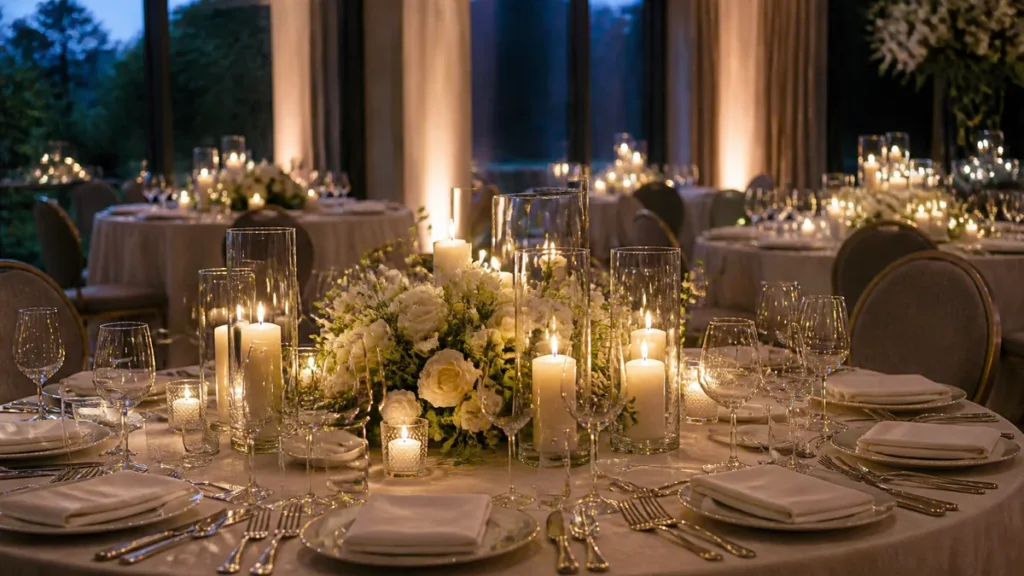
A candlelit reception is not automatically off-limits in Canada, but it is never a décor decision to make from an inspiration photo alone. Whether real flames are allowed depends first on the venue’s written policy, then on the applicable provincial fire code and local fire authority requirements. A restaurant, barn, tent, public park venue and municipal hall can each have very different limits.
The useful question is not simply “Are candles allowed?” Ask which candle types, holders, locations and quantities are approved—and get the answer in writing before ordering rentals or floral installations. This guide separates the venue decision from the fire-safety rules and gives you a practical path to a warm-looking reception that your venue can actually accept.
Start with the venue’s written rule
Your contract or event manager’s written approval is the starting point. A venue may prohibit all open flame, permit only enclosed votives, require glass chimneys around tapers, limit candles to dining tables, or insist on battery-operated candles. Its rule can be stricter than the minimum fire-code requirement because the venue also manages its building, furnishings, staffing, insurer requirements and cleanup risk.
Send a photo or simple layout of the exact look you want. “Candles on tables” is too vague to approve reliably. Identify the candle style, maximum height, holder material, whether the flame is enclosed, tablecloths and florals nearby, and whether candles will appear on the floor, aisle, bar, cake table or ceremony backdrop. Ask the venue to confirm who lights and extinguishes them, and whether your florist or rental company needs to provide the holders.
- Ask whether open flame is permitted at all, not just whether “candles” are permitted.
- Ask whether glass hurricanes or chimneys are mandatory and whether they must extend above the flame.
- Confirm restrictions on taper candles, floating candles, candelabras, aisle candles and hanging installations separately.
- Ask whether wax cleanup, broken glass or a fire-watch charge would be billed to you.
- Keep the approval with your décor plan, rental order and final venue paperwork.
Why the answer changes by province, city and building
There is no single Canada-wide wedding-candle permission. Fire safety is administered through provincial and local systems, and the authority having jurisdiction may be a municipal fire department or another local authority. The building type and event setup matter as much as the province: an occupied tent, a heritage building, a community hall and a private dining room do not present the same conditions.
Ontario’s Fire Code illustrates the principle. In public assembly buildings, open flames cannot be used in quantities or ways that create a fire hazard unless approved. Decorative or lighting devices using an open flame must be securely supported in non-combustible holders and located and protected so combustible material cannot contact or be ignited by the flame, unless they are approved. That is not a blanket permission for every centrepiece; it leaves room for venue and fire-authority decisions on the actual setup.
- In Montréal establishments, candles and other open-flame devices must be surrounded by protection that keeps flame away from combustible items; stable non-combustible holders are also required.
- In Calgary, a limited quantity of display open flames may be permitted under approved circumstances, with a written request at least seven working days before the event.
- In British Columbia, open-flame devices in publicly occupied tents or air-supported structures are not permitted unless the local authority having jurisdiction approves them.
- A city-owned venue may impose a complete ban: Ottawa City Hall, for example, prohibits open-flamed candles and incense in its event spaces.
Tents and outdoor weddings need a separate check
Do not assume that being outdoors makes real candles easier to use. Wind can make flames unpredictable, and tents introduce fabric, draping, power cords, floral installations and restricted exits. British Columbia specifically says its Fire Code does not permit open-flame devices in tents or air-supported structures occupied by the public unless approved by the local authority having jurisdiction.
For a wedding in a public park, municipal garden or other public space, the location booking may create another approval layer. Calgary lists candles and open flames among the features that can trigger special-event permit review for temporary structures or events. Your booking confirmation is not necessarily approval for an open flame. Check the site’s event conditions early, particularly if you are adding a tent, lounge area, fire feature or long aisle of lanterns.
- Ask the venue or property manager whether the tent supplier must supply flame-retardant documentation or a floor plan.
- Keep candle groupings out of egress routes, stairs, door swings and service paths.
- Treat wind, rain and wildfire-smoke conditions as reasons to move to flameless candles, not as a reason to improvise with a more enclosed flame.
- If an authority approval is required, ask who submits it and what lead time applies; do not assume a florist’s usual setup is approved for your site.
Choose an allowed candle setup, not a risky substitute
If real flame is permitted, work within the approval instead of trying to recreate a different setup on the day. A modest number of enclosed votives or pillars in stable non-combustible holders may be easier to assess than tall exposed tapers, floor-level clusters or suspended candles. Montréal’s fire service specifically recognizes glass domes, vases and other non-combustible containers as protective elements when they keep a flame from contacting combustible materials.
Avoid treating a glass vessel as a universal fix. The vessel has to be appropriate for the candle, stable on the surface and accepted by the venue. The location still matters: napkins, menus, dried foliage, paper place cards, loose sleeves and reaching guests can all turn a nominally protected candle into an unsafe arrangement. Keep the florist’s installation plan and the venue’s approval aligned.
- Use only the exact holder-and-candle combination the venue approved.
- Keep candles on stable, level surfaces rather than ledges, stairs or the dance floor.
- Place floral materials, paper goods and linens so they cannot reach the flame.
- Do not add candles to a cake table, bar or ceremony installation after the approved plan has been reviewed.
- Assign a responsible adult, planner or venue staff member to monitor and extinguish candles; do not leave the task undefined.
Know the candle products to avoid
Some products create risks beyond an ordinary single-wick pillar candle. Health Canada advises extra care with closely spaced multi-wick candles because they can create a large or high flame and melt rapidly. It also cautions against decorative materials such as paper, ribbons, bark and other non-wax coatings, which can be flammable. Those details matter when a rental package or online listing is designed for home styling rather than a crowded reception.
Do not use trick, magic or relight candles. Federal Candles Regulations require that a candle must not reignite spontaneously after it has been extinguished, and Health Canada says relight candles have been prohibited from sale, advertising and import since 1977. Decorative oil lamps and pourable-fuel features deserve separate scrutiny rather than being treated as ordinary candles; they introduce fuel handling hazards and may be prohibited by your venue even when enclosed wax candles are allowed.
- Avoid multi-wick centrepieces and candles with paper, ribbon or bark decorations.
- Do not refill oil or gel-fuel devices during an event.
- Do not use a candle holder made of wood or plastic where heat could ignite or deform it.
- Never assume a product sold as “wedding safe” has venue or fire-authority approval.
- Follow the manufacturer’s label as well as the venue’s conditions.
When flameless candles are the better decision
Battery-operated candles are the straightforward choice when the venue has a no-open-flame rule, your wedding is in a tent without approval, children will be close to the décor, or your plan relies on many candles in several spaces. They also make sense when candles need to remain lit during a long reception without asking staff or family members to supervise each table.
A flameless design can still look deliberate. Use a consistent candle colour temperature, mix a few approved vessel shapes and heights, and test the display in the actual room or at a similar dusk level before committing. Ask whether the venue has restrictions on batteries, charging, timer use or disposal. If you rent the units, confirm who installs them, supplies replacement batteries and collects them after the event.
- Choose flameless candles if an open flame is not expressly approved.
- Test the effect after sunset or in the same indoor lighting conditions.
- Use a controlled mix of heights instead of an unplanned scatter of LEDs.
- Include battery checks and activation in the décor setup timeline.
- Keep real flame out of the plan once you have chosen a flameless alternative; last-minute substitutions can invalidate the approval.
Build candles into your final venue and décor plan
Raise the candle question before booking a florist, rental company or venue if a candlelit look is important to you. Then revisit it when the floor plan is final. A changed guest count, added tent, relocated bar, ceiling draping or altered head-table design can change the safety assessment. Where a municipal review is required, submit the current plan rather than an early concept drawing.
Your final file should show the candle locations and counts, holder specifications, responsibility for lighting and extinguishing, and the fallback plan. This is especially useful when several parties are involved: venue, planner, florist, rental company, caterer and tent supplier. It prevents the common day-of problem where a delivery arrives with a candle style that the venue never approved.
- Review the venue contract’s décor, damage, insurance and vendor-compliance clauses.
- Give all vendors the same approved floor plan and candle specification.
- Confirm setup access time so the team is not rushing to place or light candles.
- Plan a flameless backup for weather, wind, a changed room or a fire-authority instruction.
- At teardown, confirm who checks that every flame is out and removes wax, glass and batteries.
A quick decision checklist for couples
Use this sequence to decide quickly. First, obtain the venue’s written policy. Second, submit a visual of the exact design. Third, determine whether the location, tent or special event requires local fire approval. Fourth, choose an approved real-flame design or commit to flameless candles. Finally, put monitoring, extinguishing and cleanup in the event timeline.
If any answer remains uncertain close to the wedding, choose flameless candles. The aesthetic trade-off is manageable; a last-minute refusal, fire hazard or contract dispute is not. Couples using a public facility or temporary structure should leave extra time because local review can require site details and a floor plan.
- Written venue approval received
- Exact candle, holder, count and locations confirmed
- Local authority or permit requirement checked where applicable
- Flammable décor and exit routes reviewed
- Named person assigned to light, monitor and extinguish
- Flameless backup packed or available
Continue planning
- wedding venue contract checklist
- public park wedding permit guide
- Canadian wedding weather contingency plan
- Canadian wedding insurance guide
Frequently asked questions
Are real candles legal at a wedding venue in Canada?
They can be, but there is no Canada-wide yes or no. The venue’s written policy, the provincial fire code and any local fire-authority approval determine what is permitted. A venue may allow only enclosed candles or none at all.
Can a venue require flameless candles even if the fire code permits open flame?
Yes. A venue can impose stricter event rules in its contract or décor policy. Its approval is required for the use of its space, so do not rely on a general reading of the fire code alone.
Do candles in glass hurricanes count as enclosed?
They may, but approval is still needed. Montréal identifies glass domes and vases as protective elements when they prevent flame contact with combustible materials, but the venue or local authority must accept the specific candle-and-holder setup.
Are candles allowed in a wedding tent in Canada?
Do not assume so. British Columbia states that open-flame devices are not permitted in publicly occupied tents or air-supported structures unless approved by the local authority having jurisdiction. Other provinces and municipalities can also impose requirements or bans.
Do we need a permit for wedding candles?
Often a normal indoor reception will be handled through the venue’s existing rules, but permits or fire review can be required for public facilities, temporary structures, parks or special events. Calgary, for example, identifies candles and open flames as features that may trigger special-event review.
Who should light and extinguish wedding candles?
Follow the venue’s instruction. Put one named, sober and responsible person or venue staff member in charge of lighting, monitoring and fully extinguishing them. Do not leave this to guests or an unassigned member of the wedding party.
Sources and verification notes
These sources were reviewed on August 11, 2026. Requirements, prices and availability can change; confirm time-sensitive details directly.
- Candle Safety — Health Canada
- Candles Regulations (SOR/2016-165) — Government of Canada, Justice Laws Website
- O. Reg. 388/97: Fire Code — Government of Ontario
- Open flames — Service de sécurité incendie de Montréal
- Fire codes — City of Calgary
- Fire safety codes and bulletins — Province of British Columbia
Recent Ratings
-

Olivia Marie Events

Ontario » Barrie ()
-

Tamea Burd Photography
British Columbia » Vancouver (Wedding Photography)
-

the barn 1906
Ontario » Bradford (Farm Weddings)
-

M2S Photography

Alberta » Edmonton (Wedding Photography)
-
The Club at North Halton
Ontario » Halton Hills (Wedding Banquet Halls)
-

Monolith Photo
Ontario » Mississauga (Wedding Photography)
-

Rebecca Elizabeth Louise Photography
Ontario » Ottawa (Wedding Photography)
-

Aneta Elizabeth Photography
Ontario » Newmarket (Wedding Photography)
Popular Listings
-

Blue Clover Paperie
530 viewsQuebec » Laval-Ouest (Wedding Invitations)
-

Auberge du Vieux Port
564 viewsQuebec » Montreal (Hotel Weddings)
-

Henkaa
387 viewsOntario » Toronto (Cocktail Dresses)
-

Fairmont Le Chateau Frontenac
542 views» Quebec (Castle Wedding)
-

Bethesda Karen Baptist Church ( The Little White Chapel )
554 viewsBritish Columbia » Chilliwack (Wedding Banquet Halls)
-

Stacey Foley Design
471 viewsAlberta » Cochrane (Wedding Planning)
-

Sherry Smith Photography
538 viewsOntario » Brantford (Wedding Photography)
-

Halifax Wedding Chapel and Marriage Officiants
573 viewsNova Scotia » Halifax (Wedding Officiants)