Food Truck Wedding Catering in Canada: Venue, Permits and Service Plan
Published: August 15, 2026 Last reviewed: August 14, 2026.
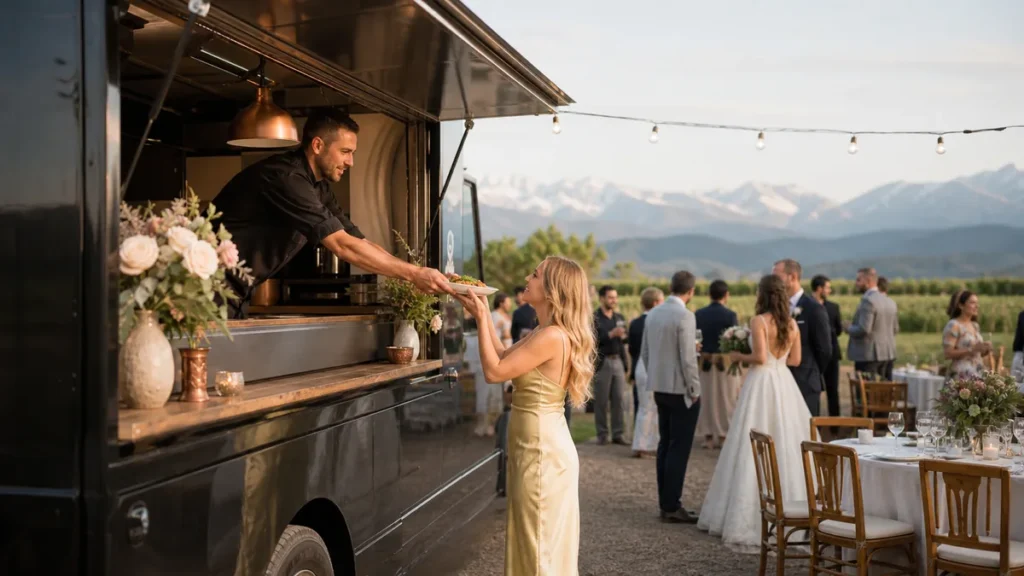
A food truck can make a Canadian wedding meal feel relaxed and highly personal, whether you are serving late-night poutine, a single-course menu or several distinct stations. It is not automatically the simpler catering choice, though. The truck must be able to reach its service location, operate safely, serve your guest count within the available meal window and meet the rules that apply where it parks.
The useful question is not simply “Can we hire a food truck?” It is “Can this specific truck serve this menu at our specific venue, on this date, with a workable plan for power, waste, weather and queues?” Start those conversations before treating the truck as a replacement for a conventional caterer. Last reviewed: August 14, 2026.
Decide whether a food truck fits the meal you want
Food trucks work best when the food and the rhythm of the reception agree. A compact menu with items that can be finished quickly to order can suit a casual dinner, cocktail-style reception or late-night snack. A seated reception with speeches, formal courses and a short dinner window requires a more deliberate service plan; guests still need to receive food in a reasonable sequence, including anyone with a dietary restriction or a mobility-related need.
Choose the service model before choosing the menu. A hosted truck means the couple pays the vendor under the catering agreement; guests are not expected to transact at the window. A ticket or voucher system can control who receives a meal, but it introduces distribution and redemption logistics. Pay-your-own-way service changes the guest experience and should be made unmistakably clear before the wedding. Confirm with the vendor whether its staffing, point-of-sale setup and menu are designed for the model you choose.
A truck is not inherently a budget option. Quotes may be structured as a minimum spend, a per-guest package, menu pricing, service hours or a combination. Ask for a written quote that identifies what is included and what could be added for travel, staffing, equipment, power, site access, gratuity, tax or a longer service period. Do not compare a food-truck quote only with a plated per-person price; compare the complete meal and logistics plan.
- Best fit: a focused menu, flexible dining time and a venue with a practical exterior service area.
- Proceed carefully: a large guest list, several made-to-order choices, a tightly timed seated dinner or limited accessible outdoor space.
- Alternative: use the truck for cocktail hour or late night while your venue or caterer handles dinner.
Confirm the venue can physically host the truck
Get the venue’s approval in writing, even when the truck will sit in a parking area. The venue controls the site and may have rules about where vendors park, arrival routes, pavement loading, generator noise, fuel, fire lanes, waste, curfews and outdoor cooking. A public-site wedding has an additional layer: permits and event conditions may be set by the municipality or park authority.
Give the food-truck operator a site plan and arrange a direct conversation with the venue contact. They should confirm the arrival and departure route, turning and reversing space, service-window direction, location of guests in line, the distance to dining tables and whether the truck will block deliveries, accessible parking, emergency access or photography locations. A beautiful field is not automatically a workable truck location after rain, and a narrow heritage driveway may not accommodate the vehicle.
Also verify the site utilities. Some operators are self-contained; others may need a suitable electrical connection. Never promise venue power without confirmation from the venue and truck operator. If a generator is proposed, ask where it will sit, how sound and exhaust will affect guests, whether the venue allows it, and who is responsible for fuel and safe shutdown. The City of Vancouver’s special-event handbook illustrates why public-event planning can involve separate questions for food, permitted vendors, generators, building power and gas features; those listed steps are city- and event-specific, not a Canada-wide wedding rule.
- Ask the venue: Where may the truck park and queue? What are its arrival, service and departure times?
- Ask the operator: What vehicle dimensions, clearance, surface and utility needs apply to this truck?
- Protect: fire lanes, emergency exits, accessible routes, accessible parking and the rain-plan location.
Treat permits and inspections as local, not national
Canada does not have one food-truck wedding permit. Requirements can come from provincial or regional public-health rules, municipal business licensing and vending rules, fire or gas-safety authorities, and the property owner. In many cases the food-truck business, rather than the couple, holds the licence or obtains operational approvals. Your job is to confirm that the operator is authorized for the location and type of service in the contract—not to assume a licence from one municipality travels everywhere.
Toronto is a useful example of the local distinction. The City says a food truck may operate on private property or a commercial parking lot with the owner’s permission in areas where food trucks are allowed; operating on public roads is subject to its mobile-vending permissions and conditions. Toronto also requires food-truck licence applicants to provide, among other documentation, liability insurance, a public-health inspection letter and proof of propane or natural-gas inspection where relevant. Those are Toronto requirements, not a checklist for every Canadian wedding.
Alberta Health Services’ March 2026 special-event vendor package is another example. It calls for a food-vendor notification 30 days before a special event, but says an AHS-permitted mobile establishment operating within its permit conditions does not need that notification and instead provides the organizer with its name, decal identification and contact information. Ask the local health authority and the vendor which pathway applies to your exact event; do not rely on an event package from another province.
In British Columbia, Technical Safety BC sets specific approval requirements for enclosed mobile outdoor food-service units using propane. The unit must bear an accepted certification or approval mark, or an applicable Technical Safety BC decal; the directive also makes the operator responsible for other requirements such as electrical, plumbing, fire safety, local-health-authority rules, bylaws and licensing. That is a strong reason to hire an established operator and ask it to confirm compliance rather than asking an amateur vendor to improvise a mobile kitchen.
- Give the vendor the exact address, municipality, date, service hours and whether the site is private or public.
- Ask which licences, health approvals, inspections and insurance apply to this service location.
- Have the venue confirm its own approval and any site-specific fire, generator or access conditions.
- If the event is on municipal land, contact the permitting authority early; a venue’s verbal approval does not replace a public-site permit.
Build a queue and dinner timeline, not just a menu
The main operational risk is not the truck itself; it is a line of hungry guests arriving at the same small service window. Ask the operator how it proposes to serve your anticipated guest count within your available time, with your selected menu and its planned staffing. Request that answer in writing. Avoid asking for a universal guests-per-hour figure: preparation time varies enormously between a pre-portioned handheld item and an assembled, cooked-to-order dish.
Then decide who is called when. You may release tables in groups, invite the wedding party to eat first, arrange a separate meal drop for vendors, or use pre-selected meal tickets. A simplified menu can reduce decision time and protect dietary accommodations. If a guest needs an accessible route or cannot comfortably stand in a long line, set up a table-service alternative or arrange a named person to assist; do not leave that responsibility to the guest at the event.
Place speeches, first dances and sunset photographs around the actual meal flow. If you plan a food truck during cocktail hour, make sure guests who were in the ceremony or family photos have an equivalent chance to eat. If it is the late-night food, decide whether it is an optional snack or the main food available after a certain time. These decisions belong on the final wedding-day timeline and should be shared with the venue, planner, MC and photographer.
- Ask for: menu, staffing plan, estimated service window, dietary process and final headcount deadline.
- Plan: a queue area with lighting, weather cover if permitted, seating nearby and a clear accessible path.
- Coordinate: ceremony end, cocktail hour, speeches, photos, bar service and truck departure.
Plan allergies, dietary needs and food safety early
Collect dietary restrictions in the RSVP process, then give the final list to the operator before the contract’s deadline. Ask what the truck can genuinely provide, whether an item is prepared separately and how the staff will identify the guest who ordered it. Never promise that a food truck can accommodate an allergy unless the operator has confirmed its process. For a guest with a serious allergy, direct confirmation between the guest and food business may be appropriate, with the guest’s consent.
Make the plan operational. A separate pre-ordered meal can prevent a guest from standing in the general queue only to learn that an option has sold out or cannot be modified. Confirm children’s portions, vegetarian and vegan availability, non-alcoholic drinks, and whether the venue supplies water, tables, napkins or garbage bins. Link these questions to your broader RSVP and catering record rather than maintaining an informal text-message list.
Food safety remains the responsibility of the food business and relevant regulators, but couples can avoid preventable problems by choosing a licensed, established operator and not requesting unsafe workarounds. Alberta Health Services states that special-event food and ingredients must come from approved sources and that advance preparation away from the event must occur in an approved food establishment, subject to stated exceptions. Do not ask a vendor to prepare a regulated menu in a home kitchen or hold perishable food beyond its safe process.
- Send the operator a final, written dietary list and retain its confirmed menu response.
- Set a cut-off for meal changes and name one day-of contact who can handle questions.
- Arrange a defined plan for unserved meals and leftovers with the venue and operator before the event.
Put food-truck responsibilities into the contract
Your agreement should make it obvious who is responsible for each part of the operation. Use the food-truck operator’s name, the exact event location, service hours, chosen menu, included guest count or spending structure, and the amount and timing of every payment. Add the venue-approved location and any agreed arrival or departure time. If the operator needs information from you—such as final numbers, dietary selections, electrical access or a site map—record the deadline and the consequence of a late change.
Ask what happens if weather, a vehicle breakdown, road closure, staffing problem or venue restriction prevents service. The answer might be a substitute vehicle, an alternate menu, delivery from a commissary kitchen, a refund term or another defined remedy. Do not assume a backup exists. A weather contingency is especially important at remote, rural, waterfront and winter venues, where ground conditions and travel can affect access.
Confirm insurance requirements with the venue and compare them with the operator’s certificate of insurance. The City of Toronto, for example, requires food-truck licence applicants to provide proof of $2 million commercial general liability insurance. Your venue may request different limits, additional insured wording or its own vendor form. Read the venue contract as well as the food-truck agreement, because the stricter site condition can control whether the truck is permitted to serve.
- Written scope: menu, portions, service hours, travel, staffing, rentals, tax and gratuity treatment.
- Written site plan: parking location, power or generator, guest line, waste and emergency access.
- Written fallback: weather, mechanical failure, late arrival, menu substitutions and cancellation terms.
- Written approval: venue authorization and proof of the vendor documents the venue requires.
Use a final 30-day food-truck checklist
Thirty days out, reconfirm the entire chain: venue, operator, planner or coordinator, and any public-land permitting contact. Alberta’s special-event guidance uses a 30-day vendor-notification timing, but your local deadline may differ or may not apply; use it as a reminder to verify the applicable requirement rather than as a universal deadline. Ask for the day-of driver and manager contacts, arrival window and a final site diagram.
In the final week, confirm the guest count, dietary meals, timeline, weather response and service start. On the wedding day, have one informed person meet the truck, direct it to the approved position and keep the venue aware of any change. Couples should not be troubleshooting utility connections or guest queues after the ceremony. A food truck is a great fit when its work has already been integrated into the event plan.
- 30 days: verify local permissions, venue approval, insurance documents and site plan.
- Two weeks: lock menu choices, dietary meals, service order and headcount according to the agreement.
- One week: share the final timeline and contacts; reconfirm weather and access plan.
- Day of: designate a coordinator, protect access routes and use the agreed guest-release plan.
Continue planning
- wedding venue contract checklist
- wedding dietary restrictions RSVP and catering checklist
- accessible wedding-planning checklist
- Canadian wedding weather contingency plan
- wedding insurance guide
Frequently asked questions
Do you need a permit for a food truck at a private wedding venue in Canada?
Possibly. Private-property permission from the venue or owner does not remove municipal, public-health, fire, gas-safety or business-licensing requirements that may apply to the operator. The exact answer depends on the municipality, province or territory, menu, equipment and site. Ask the operator and the local authority responsible for the location.
Is a food truck suitable for a 100-person wedding?
It can be, but only if the operator provides a credible plan for the selected menu, staffing and service window. Guest count alone cannot predict queue length. Consider releasing guests in groups, simplifying choices, adding a second service point or using the truck for late-night food instead of the full dinner.
Who supplies power for a wedding food truck?
It depends on the operator and venue. Some trucks are self-contained; others may require a suitable electrical connection or use a generator. Confirm the technical requirements directly with the operator and get the venue’s written approval before booking.
Can a food truck handle wedding dietary restrictions?
Many can accommodate selected dietary needs, but capabilities and cross-contact processes differ by menu and vehicle. Collect requirements on the RSVP, ask the operator for a written response, and arrange pre-ordered or separately handled meals when the vendor confirms that option.
Should guests pay at a food truck wedding?
That is a hosting choice, not a food-truck requirement. If guests will pay or use vouchers, explain the arrangement clearly in advance and ensure the service setup supports it. For a conventional hosted meal, include the food cost in your catering agreement so guests are not unexpectedly asked to pay.
Sources and verification notes
These sources were reviewed on August 14, 2026. Requirements, prices and availability can change; confirm time-sensitive details directly.
- Food Trucks — City of Toronto
- Special Events Food Vendor Package — Alberta Health Services
- Directive: Mobile Outdoor Food Service Unit Gas Approval Requirements — Technical Safety BC
- Special Event Permitting Handbook — City of Vancouver
Recent Ratings
-

Olivia Marie Events

Ontario » Barrie ()
-

Tamea Burd Photography
British Columbia » Vancouver (Wedding Photography)
-

the barn 1906
Ontario » Bradford (Farm Weddings)
-

M2S Photography

Alberta » Edmonton (Wedding Photography)
-

The Club at North Halton
Ontario » Halton Hills (Wedding Banquet Halls)
-

Monolith Photo
Ontario » Mississauga (Wedding Photography)
-

Rebecca Elizabeth Louise Photography
Ontario » Ottawa (Wedding Photography)
-

Aneta Elizabeth Photography
Ontario » Newmarket (Wedding Photography)
Popular Listings
-

Bethesda Karen Baptist Church ( The Little White Chapel )
554 viewsBritish Columbia » Chilliwack (Wedding Banquet Halls)
-

Bearfoot Bistro
521 viewsBritish Columbia » Whistler (Restaurant Weddings)
-

olive + piper
326 viewsBritish Columbia » Vancouver (Wedding Accessories)
-

Alice Li Alternations
329 viewsOntario » Markham (Wedding Dresses)
-

Blue Clover Paperie
530 viewsQuebec » Laval-Ouest (Wedding Invitations)
-

Heaven on 5th
552 viewsOntario » Mono (Farm Weddings)
-

AJ & CJs DJ Services
531 viewsAlberta » Raymond (Wedding DJ)
-

Rainbow’s Roost
1,053 viewsBritish Columbia » Kamloops (Farm Weddings)