Can You Use a Drone at a Wedding in Canada? Rules, Permissions and a Safe Plan
Published: August 13, 2026 Last reviewed: August 13, 2026.
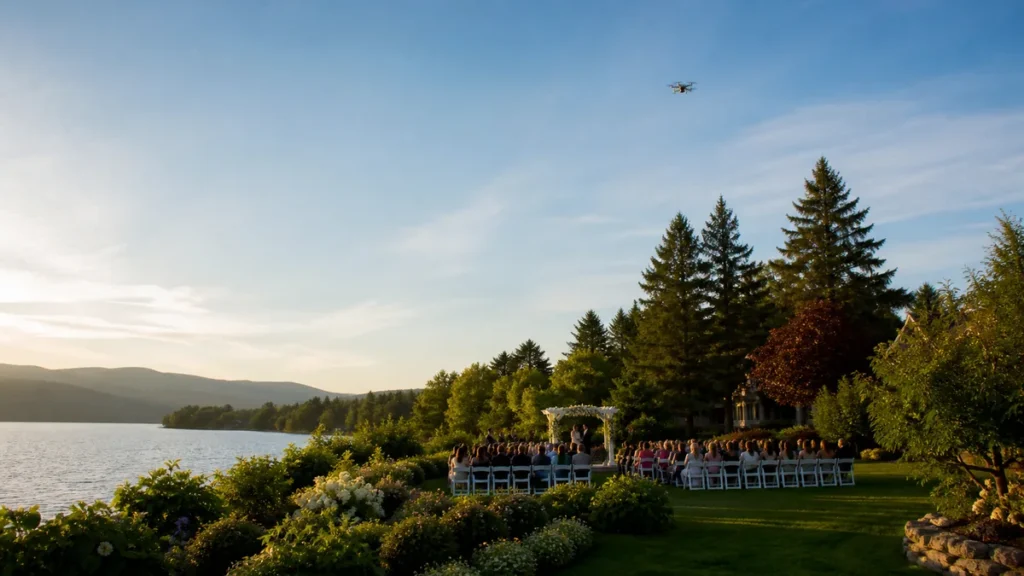
A drone can create a striking establishing shot of a mountain venue, waterfront ceremony or estate reception—but it is not an automatic add-on to wedding photography in Canada. The answer depends on the aircraft’s operating weight, how close it will fly to people, the airspace, the site owner’s rules and whether the event is open to the public.
Start the conversation before you sign a photo or video contract. Transport Canada treats drones as aircraft, and a private wedding may still have a poor or unlawful flight location because of controlled airspace, a nearby heliport, a park restriction, weather or the practical reality of a crowded ceremony. A clear plan lets you keep the aerial footage that adds value and skip the flight that creates risk or disruption.
Start with the wedding location, not the drone package
Ask your photographer or videographer what aerial shot they propose, where the pilot would launch and land, and when the flight would happen. A wide exterior shot before guests arrive is a very different operation from hovering above a ceremony, cocktail hour or dance floor. The location should be confirmed before promising drone coverage in a shot list.
Canada’s federal aviation rules apply across provinces and territories, but permission to use the ground site is separate. A private venue can prohibit drones or set conditions such as an approved launch area, proof of insurance, a restricted flight window or no flights while guests are present. Provincial parks, municipal parks, conservation areas and heritage sites can also have their own site-use rules or permits. Obtain the owner or managing authority’s written approval; a pilot’s federal qualification does not replace it.
Treat a venue’s social-media footage as inspiration, not permission. It may have been filmed under different weather, occupancy, authorization or venue rules. Put the venue’s drone decision into the contract or event file alongside other location conditions, using the same care as a venue contract checklist.
- Ask whether drones are allowed anywhere on site, including parking lots and adjacent grounds.
- Confirm who gives written approval: venue manager, landowner, park authority or municipality.
- Ask for the exact launch/landing location and the planned time window.
- Record any guest-area, noise, wildlife, insurance or weather restrictions.
Understand the federal category before anyone flies
Transport Canada determines the operating category using the drone’s weight and safety features, how close it will fly to people and the airspace. A microdrone weighs under 250 g. A small drone weighs at least 250 g and no more than 25 kg; the operating weight includes attached items such as optional cameras or safety cages, not just the published base weight.
For a small-drone basic operation, the pilot must remain in visual line of sight, stay out of controlled airspace and cannot fly over bystanders or closer than 30 metres horizontally to them. That will often rule out the classic overhead ceremony shot. Advanced operations can allow a suitably qualified pilot using a drone with the required manufacturer safety declaration to operate closer to, or over, people, but the certificate alone is not enough.
A microdrone does not require registration or a pilot certificate under the standard categories, but it is not a free pass. The pilot must still operate safely, respect privacy and property laws, avoid restricted locations and follow applicable event rules. Do not assume a sub-250 g model makes a guest-crowd flight appropriate.
- Ask for the drone’s operating weight with its planned battery, camera and accessories.
- Ask whether the planned flight is basic, advanced or requires a special authorization.
- For a 250 g-or-heavier drone, confirm registration and the pilot certificate that matches the operation.
- If the proposed route is near or over guests, ask what manufacturer safety declaration and operational controls apply.
A private wedding is usually not an advertised event—but confirm the facts
Transport Canada defines an advertised event as an outdoor event advertised to the general public. Its guidance specifically identifies a private, invitation-required wedding that is not open to the public as an example that is not an advertised event. That distinction matters because flying any drone at an advertised event, including a microdrone, requires a Special Flight Operations Certificate for Remotely Piloted Aircraft Systems (SFOC-RPAS).
Do not rely on the label “private wedding” if the event has public access or is promoted in a way that changes the facts. Transport Canada asks pilots to consider whether the event is advertised to the public, how it is advertised, whether the public can access the site and whether the drone will fly within 30 metres of the event boundary. The operator, not the couple, should assess the event classification.
If an SFOC-RPAS is needed, this is not a last-week task. Transport Canada says processing depends on the completeness and complexity of the request and lists a service standard of up to 30 working days for an accepted advertised-event application. The application also calls for the organizer’s and landowner’s permission.
- State in the vendor brief whether attendance is invitation-only and the site is closed to the public.
- Tell the operator about public listings, open-house elements, markets, festivals or public programming at the venue.
- If the operator says an SFOC-RPAS is required, ask them to manage that process before confirming drone coverage.
- Keep a ground-camera alternative in the timeline while authorization is unresolved.
Check airspace, airports and temporary restrictions early
A beautiful venue can be unsuitable for an aerial flight. Before operating, pilots must survey the area and identify controlled or restricted airspace, as well as nearby aerodromes, airports and heliports. Transport Canada directs pilots to the National Research Council’s Drone Site Selection Tool and NAV CANADA’s NAV Drone service for this planning.
A pilot needs at least an Advanced Pilot Certificate, an appropriate drone safety declaration and the relevant air-navigation authorization to operate in controlled airspace. For airspace controlled by NAV CANADA, the pilot can request permission through NAV Drone. A venue address alone is not enough: the approved area and altitude matter, and restrictions can differ within the same region.
The check is especially important for urban hotels, waterfront properties, resort communities and venues near seaplane bases or heliports. Transport Canada also identifies temporary NOTAMs, emergency sites, wildfire areas and restricted airspace as conditions that can prohibit or materially change a flight. Make the final go/no-go decision on the wedding day after the pilot’s current checks, rather than relying on an early planning screenshot.
- Give the operator the exact venue address, ceremony lawn and proposed launch point.
- Ask them to check controlled airspace, airports, heliports, aerodromes and current NOTAMs.
- Allow a no-drone alternative if wildfire, emergency or temporary airspace restrictions arise.
- Do not schedule a must-have aerial shot in the only few minutes available for portraits.
National parks need a separate answer
A national-park wedding is not simply a scenic version of a private-venue wedding. Transport Canada states that drone pilots cannot take off or land within a national park unless allowed by the park superintendent. Parks Canada says its places are no-drone zones for recreational use and strictly limits non-recreational use.
For commercial video or photography at a Parks Canada place, the intended drone use must be identified in the film and photography permit application. Parks Canada evaluates applications individually, and authorization requires both park permission and compliance with Transport Canada requirements. A federally valid drone certificate therefore does not create permission to fly from park land.
For provincial, territorial and municipal parks, use the managing agency’s current rules for the specific property instead of extending the national-park rule to every park. If written approval is unavailable, build the imagery around permitted ground photography and use the site’s natural backdrop without attempting a launch.
- For a Parks Canada location, contact the specific park or site well before the wedding.
- Identify the drone in the applicable film and photography permit process.
- For every other public park, check the specific park operator and municipal event permit conditions.
- Keep a portrait location outside the restricted site if aerial imagery is essential.
Build a guest-first flight plan
The most elegant wedding drone work is often brief and deliberate. A flight during setup, after the ceremony site has cleared or from a controlled open area can capture context without putting the aircraft above people or adding a motor sound to an important moment. The pilot should be the sole decision-maker on whether conditions are safe and lawful; couples and coordinators should not pressure a flight because the timeline is tight.
Tell guests in advance if a drone will be used, especially if it may be visible near shared outdoor areas. This is a practical courtesy and helps guests with sensory sensitivities, privacy concerns, young children or service animals prepare. It is also useful to designate a coordinator who can keep the launch area clear and communicate a last-minute cancellation without debate.
Avoid using a drone for ceremony audio. Aerial footage can be paired with clean audio recorded separately, while the drone is reserved for establishing imagery. This protects the experience for guests and keeps the photography timeline focused on the moments that cannot be repeated.
- Choose one or two specific aerial moments rather than open-ended coverage.
- Keep the aircraft away from the ceremony, first dance, speeches and any wildlife-sensitive area unless the operator’s plan supports it.
- Name a coordinator as the vendor’s point of contact for site access and crowd management.
- Tell guests how to raise a concern and ensure the operator can cancel without penalty to the wedding schedule.
Make the drone clause specific in your vendor contract
Do not contract for “drone footage included” without defining what that means. The photographer or videographer may reasonably need to cancel aerial coverage because authorization, airspace, wind, rain, smoke, temperature, site access or safety conditions do not support a flight. The contract should make clear that this cancellation does not mean the entire photo or video service has failed.
Ask whether the vendor operates the drone personally or hires a separate pilot, and who is responsible for licensing, registration, airspace authorization, venue approvals and insurance. The vendor should provide a non-drone substitute, such as elevated ground angles, a second-camera exterior sequence or additional portrait coverage, if the flight cannot proceed.
Review this alongside the photo timeline, venue permissions, event insurance requirements and weather contingency plan. The goal is not to force a flight—it is to prevent a surprise on the day and preserve a strong visual record either way.
- List the intended aerial deliverables and the planned flight windows.
- State that all aviation, site and airspace requirements remain the operator’s responsibility.
- Confirm any venue insurance certificate, additional-insured requirement or pilot documentation deadline.
- Specify the ground-based substitute if a drone cannot fly.
- Avoid guaranteeing a particular aerial shot when weather and authorizations are outside the vendor’s control.
A simple decision rule for couples
Drone coverage is a sensible option when the venue provides written approval, the operator can legally fly the proposed route, the site has a useful open area, the flight can happen away from key guest moments and the contract includes a quality ground-based fallback. It is less compelling when the only desired shot requires flight over a dense crowd, the venue is near sensitive airspace, the location is a restricted park site or the operator cannot explain the authorization plan.
If the choice is between a short, well-planned exterior flight and a disruptive attempt during the ceremony, choose the exterior flight. You will still have the sense of place, and your guests will have a quieter, more comfortable ceremony.
- Green light: written site permission, qualified operator, confirmed airspace plan, clear launch area and realistic backup.
- Pause: uncertain public-event status, incomplete venue approval, unclear proximity to guests or a location near aviation activity.
- Skip it: the pilot cannot show a lawful plan, a managing authority says no, or conditions on the day are unsafe.
Continue planning
- wedding venue contract checklist
- wedding photography timeline and shot list
- wedding videography packages in Canada
- public park wedding permit guide
- Canada wedding weather contingency plan
Frequently asked questions
Do you need a licence to fly a drone at a wedding in Canada?
For a drone weighing 250 g or more, the pilot needs the Transport Canada certificate appropriate to the planned category of operation. A microdrone under 250 g has no standard pilot-certificate requirement, but the pilot must still follow safety, airspace, event, property and privacy rules. A hired photographer does not receive an automatic exception.
Can a drone fly over wedding guests?
Do not assume it can. A basic small-drone operation cannot fly over bystanders or within 30 metres horizontally of them. Advanced operations may permit closer or over-people flying only when the pilot, drone and operation meet the applicable requirements. Ask the operator for the specific plan rather than treating guest consent as a substitute for aviation rules.
Is a private wedding an advertised event for drone rules?
Transport Canada lists a private, invitation-required wedding not open to the public as an example of what is not an advertised event. If the event is advertised to the public or public access changes the situation, the operator should assess it using Transport Canada’s criteria. An advertised event requires an SFOC-RPAS for any drone, including a microdrone.
Can we use a drone at a national park wedding?
Only with the relevant Parks Canada permission and compliance with Transport Canada rules. Recreational drone use is not allowed at Parks Canada places, and commercial photo or video applications must identify the proposed drone use. Do not bring or launch a drone on the assumption that a wedding permit covers it.
What if bad weather or airspace restrictions cancel the drone flight?
The photo or video contract should state the non-drone substitute before the wedding. The pilot should make the final safety decision after current weather, airspace and site checks. A strong backup can include elevated ground shots, extra exterior footage or additional portrait time.
Sources and verification notes
These sources were reviewed on August 13, 2026. Requirements, prices and availability can change; confirm time-sensitive details directly.
- Drone operation categories and pilot certificates: Overview — Transport Canada
- Flying your drone at an advertised event — Transport Canada
- Where to fly your drone — Transport Canada
- Use of drones at Parks Canada places — Parks Canada
- NAV Drone: Getting started — NAV CANADA
- Canadian Aviation Regulations — Justice Laws Website, Government of Canada
Recent Ratings
-

Olivia Marie Events

Ontario » Barrie ()
-

Tamea Burd Photography
British Columbia » Vancouver (Wedding Photography)
-

the barn 1906
Ontario » Bradford (Farm Weddings)
-

M2S Photography

Alberta » Edmonton (Wedding Photography)
-
The Club at North Halton
Ontario » Halton Hills (Wedding Banquet Halls)
-

Monolith Photo
Ontario » Mississauga (Wedding Photography)
-

Rebecca Elizabeth Louise Photography
Ontario » Ottawa (Wedding Photography)
-

Aneta Elizabeth Photography
Ontario » Newmarket (Wedding Photography)
Popular Listings
-

La Petite Chapelle
491 viewsOntario » Innerkip (Farm Weddings)
-
Narces
364 viewsOntario » Toronto (Wedding Dresses)
-

Danielle Tremblay Photography
477 viewsOntario » Windsor (Wedding Photography)
-

Bar U Ranch
579 viewsAlberta » Longview (Farm Weddings)
-

Mika Makeup
499 viewsQuebec » Beaconsfield (Wedding Makeup)
-

Stone Jug
635 viewsNewfoundland and Labrador » Carbonear (Restaurant Weddings)
-

The Carabine Trio
548 viewsOntario » Toronto (Wedding Music)
-

ZionProduction LLC
554 viewsManitoba » Winnipeg (Wedding Videography)