When to Send Wedding Invitations in Canada: A Practical Timeline
Published: August 3, 2026 Last reviewed: August 3, 2026.
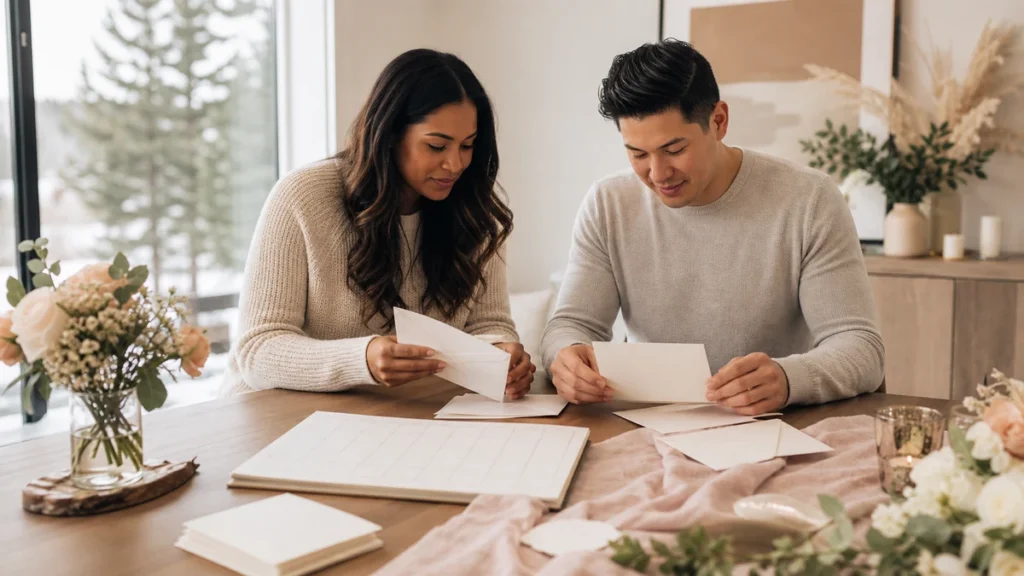
For most Canadian weddings, send save-the-dates six to nine months before the date and formal invitations about two to three months before. Travelling guests, destination celebrations, holiday weekends and weddings without save-the-dates generally need more notice. Your RSVP deadline should not be chosen from etiquette alone: it must leave enough time before the earliest venue, caterer or rental-company deadline.
Treat these ranges as planning guides rather than rigid rules. The most reliable method is to work backward from your contracts, then add time for unanswered RSVPs, printing and delivery. That approach produces a timeline suited to your wedding instead of one borrowed from a generic checklist.
The short answer: a Canadian wedding invitation timeline
A conventional local wedding can use the timeline below when most guests already live nearby and no major holiday complicates travel. VistaPrint Canada recommends two to three months of notice for local weddings, with earlier invitations for destination celebrations and international guests. Save-the-dates provide the advance warning; the invitation confirms the final schedule and collects an actionable response.
Do not send a save-the-date until the date and location are secure. Likewise, do not mail formal invitations while the ceremony time, guest eligibility or venue remains uncertain. Correcting printed information can confuse guests and create extra work.
- 9–12 months before: consider save-the-dates for a destination or travel-heavy wedding.
- 6–9 months before: send save-the-dates for most weddings.
- 4–6 months before: begin design, wording, address collection and proofing.
- 2–3 months before: send invitations for most local weddings.
- 4–6 weeks before: common RSVP window, adjusted to vendor deadlines.
Set the RSVP deadline before choosing the mailing date
Start with the earliest date on which any vendor needs confirmed numbers. Check the venue, caterer, bar service, rentals, transportation and stationery contracts; their cutoffs may differ. Set the guest RSVP deadline at least one to two weeks before that earliest cutoff. The buffer is for contacting non-responders, resolving unclear answers, confirming children and plus-ones, and completing meal and accessibility counts.
Next, give guests a reasonable response window—usually four to six weeks between expected delivery and the RSVP deadline. Then add printing, assembly and mailing time. For example, if final numbers are due four weeks before the wedding, an RSVP deadline six weeks before creates a two-week follow-up period. Invitations could then arrive roughly 10 to 12 weeks before the wedding.
- Find the earliest contractual final-count date.
- Move the RSVP deadline one to two weeks earlier.
- Allow four to six weeks for guests to respond.
- Add delivery time and a practical mail buffer.
- Place the print order early enough for proof corrections and assembly.
Adjust the timeline for local, travelling and destination guests
“Local” should describe the guest experience, not merely the venue’s province. A Toronto wedding may be local for a guest in Mississauga but travel-heavy for someone in Thunder Bay. Consider driving time, flight availability, hotel demand, time off work, childcare and accessibility arrangements.
For a mostly local list, aim for invitations to arrive two to three months before the wedding. Use three to four months when many guests must fly, the celebration spans several days or accommodation is limited. For an international or destination list, send a save-the-date as soon as the confirmed arrangements are useful—often nine to 12 months ahead—and follow with the formal invitation approximately three to six months ahead. Visa and passport processing varies, so never promise that advance notice guarantees a guest can travel.
- Local wedding: invitations about 2–3 months ahead.
- Domestic travel-heavy wedding: about 3–4 months ahead.
- Destination or international guest list: about 3–6 months ahead, after earlier notice.
- Mixed list: send together on the longer timeline or use clearly managed mailing groups.
When save-the-dates are useful—and when you can skip them
A save-the-date reserves calendar space; it is not the formal invitation and normally does not request a final RSVP. It is especially valuable for summer weekends, remote communities, resort areas, multi-day celebrations and dates near Thanksgiving, Christmas, New Year’s or provincial holidays. Include the couple’s names, wedding date, general location and website only if the website is ready for guests.
You may skip save-the-dates for a small, local wedding when guests already know the plan. In that case, send the invitation earlier—roughly three to four months before a local celebration—so the first official notice does not arrive too late. Only send save-the-dates to people you intend to invite; reducing the list afterward can create a serious expectation problem.
- Use one when guests need to reserve travel, lodging or leave.
- Skip it only when the invitation itself will provide adequate notice.
- Do not include unconfirmed times, room-block claims or transportation details.
- Keep an exact record of every household that received one.
Build in a realistic Canada Post mailing buffer
Canada Post’s published regular-letter standards are two business days locally, three within a province and four nationally, excluding the mailing day. These are estimates, not guarantees. They should therefore be the minimum transit assumption, not the amount of time between mailing and an RSVP deadline.
For domestic invitations, allow at least one to two weeks between mailing and the date on which you expect households to have received them. Add more time for remote destinations, address uncertainty or service disruptions. Canada Post has no collection or delivery on many national, provincial and territorial holidays, although its schedule lists exceptions. Consult the current calendar for the provinces or territories involved rather than assuming every August or February holiday operates identically.
International mail needs a larger buffer and destination-specific checking. Send essential travel information digitally as well, especially when guests must book before a paper invitation can reasonably arrive.
- Mail a completed sample to yourself before the main batch if timing permits.
- Avoid depositing the batch immediately before a holiday closure.
- Keep the mailing date and household list in your RSVP tracker.
- Contact guests discreetly if several invitations from one area appear delayed.
Test the finished invitation before buying postage
Postage depends on the completed envelope, not the invitation card alone. Canada Post classifies domestic Lettermail by size and weight. Standard Lettermail is 50 g or less and has maximum dimensions of 245 mm by 156 mm by 5 mm; larger or heavier pieces may fall into non-standard or oversize categories and cost more.
Assemble one full suite with every enclosure, ribbon, liner, seal and reply envelope, then take it to a post office for measurement and weighing. Repeat the check if materials change. This prevents under-postage and reveals whether a decorative choice creates unnecessary cost or processing risk.
Address formatting matters too. Canada Post advises uppercase postal codes, a space between each three-character group, no hyphen, and two spaces between the province or territory abbreviation and postal code. Accurate unit numbers and return addresses also help reduce failed delivery.
- Proof the names, date, time, venue and website from the final sample.
- Measure and weigh the fully assembled envelope.
- Confirm Canadian, U.S. and international postage separately.
- Verify postal codes with guests instead of relying on an old contact list.
- Order extra suites for errors, replacements and keepsakes.
Lock the information guests need before invitations go out
An invitation should let each recipient understand exactly who is invited, where to go, when to arrive and how to reply. Include the couple’s names, ceremony date and start time, venue name or precise location, RSVP method and full deadline. Put reception, dress-code, parking, shuttle, accommodation and accessibility details on an enclosure or wedding website when the main card would become crowded.
Clarify household details through the RSVP form. List named invitees, define whether children are included, and show whether a plus-one is available. Ask only for decisions you actually need, such as attendance, meal choice, dietary restrictions, mobility accommodations and shuttle use. Confirm with the venue how accommodation requests should be communicated and fulfilled.
Do not print uncertain room rates, transportation schedules or outdoor plans. Link to information that can be updated, and review the venue agreement before making promises about access, timing or included services.
- Use a full RSVP date, including the year when helpful.
- Test every QR code and website link on multiple phones.
- Provide a non-digital response option where guests may need one.
- State separate times and locations for ceremony and reception.
- Give guests a direct contact for accessibility questions.
Track responses and handle late RSVPs consistently
Track by invited household rather than simply counting individual replies. Record every named guest, response status, meal selection, dietary note, accessibility request, plus-one name and the date of any follow-up. This makes it easier to reconcile the final total with contracts and seating plans.
Begin polite follow-up as soon as the printed deadline passes; do not wait until the vendor cutoff. Give non-responders a specific final date and explain that numbers must then be submitted. If someone still does not answer, mark the invitation as declined rather than ordering a meal on an assumption. Apply the same process consistently, while allowing direct assistance for guests who could not use the original RSVP method.
Before submitting numbers, reconcile adults, children, vendor meals and special meals separately. Save a dated copy of the final list and confirm how the contract treats later additions or cancellations. An RSVP is valuable only when it becomes an accurate operational count.
- Check responses at least weekly after invitations arrive.
- Follow up immediately after the deadline.
- Resolve unnamed plus-ones and incomplete meal choices.
- Compare the guest total with capacity and contract limits.
- Send confirmed guests a final logistics update close to the wedding.
Continue planning
- complete wedding planning timeline
- wedding venue contract checklist
- destination wedding decision guide
- accessible wedding planning checklist
- Canadian wedding weather contingency plan
Frequently asked questions
Is six weeks too early to send wedding invitations in Canada?
Six weeks before the wedding is usually late rather than early because the invitation must arrive, guests need time to respond, and you still need a follow-up buffer. It may work for a small local wedding with no travel and a late vendor cutoff, but two to three months is safer for most celebrations.
Can we send wedding invitations six months in advance?
Yes, especially for a destination wedding or international guests. For a local wedding, six months can be unnecessarily early: details may change and guests may postpone responding. A save-the-date followed by a later formal invitation is often easier to manage.
When should the RSVP deadline be?
Place it one to two weeks before the earliest final-count deadline in your vendor contracts. That commonly results in an RSVP date four to six weeks before the wedding, but a venue requiring earlier numbers may force an earlier deadline.
Should all wedding invitations be mailed on the same day?
They can be, using the longest notice period required by the guest list. Separate domestic and international batches are also reasonable if they are planned from the start. Do not use staggered mailing to conceal an informal backup guest list; overlapping social circles can make that approach apparent.
Do digital wedding invitations follow the same timeline?
Generally, yes. Instant delivery removes postal time but does not change the notice guests need for travel, leave, childcare or clothing. Digital delivery also needs contingency planning for spam filters, outdated email addresses and guests who are uncomfortable with online forms.
What if an invitation appears to be lost in the mail?
Contact the household privately and confirm its address before sending a replacement. Share the essential details and RSVP link digitally so the guest is not disadvantaged. Record the replacement in your tracker and avoid treating a missing reply as evidence that the person received the invitation.
Sources and verification notes
These sources were reviewed on 3 августа, 2026. Requirements, prices and availability can change; confirm time-sensitive details directly.
- Lettermail Delivery Standards — Canada Post
- ABCs of Mailing — Addressing — Canada Post
- Canada Post Holiday Schedule — Canada Post
- Lettermail Size Requirements — Canada Post
- When to Send Out Wedding Invitations — VistaPrint Canada
Recent Ratings
-

Tamea Burd Photography


British Columbia » Vancouver (Wedding Photography)
-

the barn 1906
Ontario » Bradford (Farm Weddings)
-

M2S Photography
Alberta » Edmonton (Wedding Photography)
-

The Club at North Halton
Ontario » Halton Hills (Wedding Banquet Halls)
-

Monolith Photo
Ontario » Mississauga (Wedding Photography)
-

Rebecca Elizabeth Louise Photography
Ontario » Ottawa (Wedding Photography)
-

Aneta Elizabeth Photography
Ontario » Newmarket (Wedding Photography)
-

Joel Lalonde
Ontario » Ottawa (Wedding DJ)
Popular Listings
-

Bethesda Karen Baptist Church ( The Little White Chapel )
(551 views)British Columbia » Chilliwack (Wedding Banquet Halls)
-

The Old Court House
(276 views)Ontario » London (Castle Wedding)
-

Dufflet Pastries
(433 views)Ontario » Toronto (Wedding Cakes)
-

Blue Clover Paperie
(527 views)Quebec » Laval-Ouest (Wedding Invitations)
-

Alice Li Alternations
(324 views)Ontario » Markham (Wedding Dresses)
-

Homewood Limousines
(356 views)Ontario » Richmond Hill (Wedding Transportation)
-

Henkaa
(298 views)Ontario » Toronto (Cocktail Dresses)
-

Meg Seitz Photography
(325 views)Alberta » Calgary (Wedding Photography)