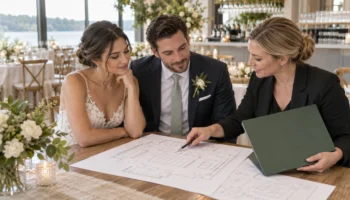
Can You Write Your Own Wedding Vows in Canada? Legal Words and Ceremony Planning
Published: August 13, 2026 Last reviewed: August 12, 2026.
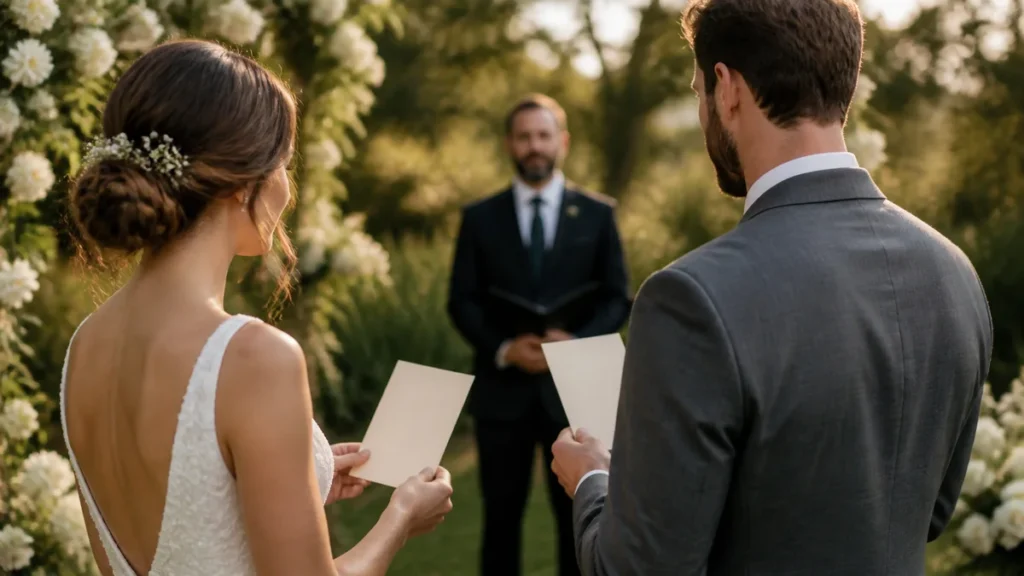
Yes, you can often write your own wedding vows in Canada—but personal promises are not necessarily the words that make the marriage legally valid. The legal ceremony is administered by the province or territory where you marry, and its required declarations, witnesses and officiant rules still apply.
The practical solution is simple: let your authorized officiant build the legal portion of the ceremony, then add your personal vows around it. This keeps the ceremony recognizably yours without asking a handwritten vow card to do legal work it may not be designed to do.
Personal vows and legal declarations are different things
A personal vow is the promise you choose to make to your partner: perhaps a short list of commitments, a story about your relationship, or words you have kept private until the ceremony. A legal declaration is wording or a formal step required by the jurisdiction for a marriage to be solemnized and registered. They can happen in the same ceremony, but they serve different purposes.
That distinction matters most for a civil ceremony. Alberta, for example, says that each person marrying in a civil ceremony must make two legislated statements before their intended spouse, witnesses and marriage commissioner. British Columbia publishes an approved sample ceremony and says its bolded words must be included in every civil ceremony, while optional sections can be discussed with the marriage commissioner.
Do not assume that a ring exchange, a shared “I do,” a signing moment or a beautifully written promise is sufficient on its own. Your officiant should identify the mandatory steps and tell you where your personal words fit.
- Treat the legal declaration as required ceremony content, not as a script suggestion.
- Treat personal vows as an additional exchange unless your officiant confirms otherwise.
- Ask about the legal wording before you finalize printed programs or vow cards.
- Keep the officiant’s approved ceremony order with your day-of coordinator.
Start with the rules where the ceremony will take place
Marriage rules are provincial and territorial. A couple planning a destination wedding within Canada should confirm requirements for the location of the ceremony, rather than relying on a ceremony script from home or one used by friends elsewhere. The authorized officiant for that location is the most useful first contact because they conduct the ceremony and handle the required registration process.
The degree of flexibility also depends on the type of ceremony. Alberta distinguishes between a civil ceremony by an appointed marriage commissioner and a religious ceremony by clergy registered with Vital Statistics. Its government guidance says clergy perform religious marriages according to the rites and usages of their recognized religious organization. That means a faith community may have ceremony requirements in addition to the provincial legal requirements.
If you are using a venue package, a friend’s script or an online template, regard it as a planning starting point only. It cannot establish whether the required words, witnesses, interpreter arrangements and authorization are correct for your wedding.
- Confirm the province or territory of the actual ceremony site.
- Verify that the officiant is authorized there.
- Ask whether the ceremony is civil, religious or another permitted format.
- Ask whether your personal words need advance review.
- Confirm the language and interpretation plan before the wedding day.
Alberta: civil ceremonies include two required statements
Alberta is unusually clear about the words used in a civil ceremony. Its guidance says that each person marrying must declare two legislated statements in front of their intended spouse, both witnesses and the marriage commissioner: one about knowing of no lawful impediment to the marriage, and one taking the other person as spouse. Those statements are separate from any personal promise you decide to write.
For an Alberta civil wedding, build your ceremony so that both required declarations are comfortably heard and not lost in a rushed entrance, wind noise or emotion. The province also requires the couple and two adult witnesses to be physically present with the officiant. It notes that an interpreter or translator may be needed when members of the wedding party are not fluent in the ceremony language or English forms; speak with the officiant well in advance if that applies.
Alberta also says a symbolic or mock ceremony cannot be registered as a legal marriage. Couples planning a private legal ceremony and a larger celebration later can certainly have meaningful personal vows at either event, but they should be clear which event is the legal one.
- Ask the commissioner to show you where the two legislated declarations appear in the ceremony.
- Place personal vows before or after those declarations as the commissioner directs.
- Ensure both adult witnesses can hear and understand the required portion.
- Discuss interpretation before selecting bilingual vow readings.
- Do not mistake a symbolic ceremony for the legal marriage ceremony.
British Columbia: required civil words, flexible optional sections
British Columbia’s Vital Statistics Agency provides an approved sample wedding ceremony for marriage commissioners. The agency says the bolded words in that sample must be included in all civil ceremonies, but couples may discuss changes to the optional sections with their commissioner. This is a useful model for couples who want a personal ceremony without guessing which parts are legally fixed.
In practice, ask your commissioner to separate the ceremony into three groups: mandatory wording, optional officiant remarks and your personal contributions. Your vows, readings, music, family acknowledgements and ring wording are much easier to plan once you know which group each item belongs to.
Do not leave this conversation until the rehearsal. British Columbia’s published commissioner fees include preparation and a meeting with the couple in the base civil ceremony, but additional time may carry extra charges. If you want long vows, several readings, a cultural ritual or a remote ceremony location, raise that scope when booking rather than assuming it fits within a standard appointment.
- Request the commissioner’s current ceremony process or sample wording.
- Mark mandatory and optional passages on the working script.
- Send personal-vow timing and readings before the commissioner’s requested deadline.
- Ask how ceremony length, rehearsal travel or location changes affect the booking.
- Bring a printed backup of each vow card in case a phone or tablet is impractical.
Quebec: plan personal words around four legal steps
Quebec’s official guidance for marriage officiants sets out four legal steps for a valid ceremony: reading the required legal text in front of two witnesses, obtaining each spouse’s consent, declaring the spouses married, and having the declaration documents signed. The required legal text differs depending on whether the ceremony is a marriage or a civil union.
This does not mean a Quebec ceremony must feel impersonal. It does mean the personal-vow exchange should be designed around the required sequence, not substituted for it. Ask the authorized officiant whether personal promises are best placed before the legal text, after the exchange of consent or at another point in the ceremony they approve.
Quebec says the consent step is completed in French or English as requested by the couple. If one intended spouse does not understand either language, the couple may hire an interpreter. This is a legal-accessibility issue, not a detail to solve by handing a bilingual guest a last-minute script.
- Confirm the exact legal sequence with the officiant.
- Keep your personal vows separate from the required consent response.
- Arrange an interpreter early if one spouse does not understand French or English.
- Ensure the two witnesses are present for the required legal text and consent.
- Review names and details on the documents before signing.
Use a ceremony script that makes the legal and personal moments clear
The strongest ceremony scripts are organized by purpose, not just by emotion. Start with the officiant’s required structure. Then add the welcome, readings, music, personal vows, ring exchange and any cultural elements in the places the officiant approves. This protects the legal part if a ceremony must be shortened or a coordinator has to make a quick decision.
Give the officiant a clean master script, even if you want your personal vows to remain a surprise to one another. The officiant does not need to edit the sentiment to manage the ceremony order, but they do need to know whether you will speak for one minute or five, whether a reader needs a microphone and whether a translation follows each vow.
A separate ceremony script also helps your witnesses. They should know when they are needed to sign, but they should not be asked to guess whether the legal portion has been completed. This is particularly useful for outdoor celebrations, where wind, weather and a limited sound system can affect pacing.
- Opening and welcome.
- Any required legal declarations led by the authorized officiant.
- Readings, music or cultural elements.
- Personal vows.
- Ring exchange or other optional ritual.
- Pronouncement and signing, in the officiant’s required order.
Make personal vows workable on the day
Good vows are not necessarily long vows. Set a shared expectation for tone and length so one person does not arrive with three minutes of promises while the other has two sentences. You can agree on a time limit, a number of promises or a loose structure without sharing the full text.
Write for speaking, not for reading silently. Use large type, short paragraphs and a page that does not flap in the wind. Practise once aloud at a calm pace. If a vow includes an inside joke, a difficult family history or a highly private story, decide together whether it belongs in the public ceremony, in a letter exchanged privately or in a reception speech.
Finally, do not use personal vows to make commitments you intend as a legally enforceable agreement about property, support or other family-law matters. Vows are ceremonial promises. If you need legal advice about a cohabitation agreement or marriage contract, obtain independent legal advice rather than trying to put terms into a ceremony script.
- Agree on a target length and tone.
- Use a printed card with a second backup copy.
- Give the officiant or coordinator timing information.
- Confirm microphone and interpretation needs.
- Keep legal agreements separate from personal wedding vows.
Continue planning
- who can legally officiate a wedding in Canada
- wedding witness requirements in Canada
- marriage licence rules by province
- difference between a marriage licence and a marriage certificate
- Canadian wedding weather contingency plan
Frequently asked questions
Can we write our own wedding vows in Canada?
Often, yes. Personal vows can usually be included, but they should not replace legal declarations or required ceremony steps. Confirm the approved ceremony order with the authorized officiant where you will marry.
Are personal vows legally binding in Canada?
Personal vows are meaningful ceremonial promises, but the legal validity of the marriage depends on meeting the requirements of the province or territory, including the proper officiant and required ceremony process.
Can we just say “I do” at a civil wedding?
Do not assume so. Alberta requires two specific legislated declarations in civil ceremonies, and British Columbia requires the bolded words in its approved civil ceremony sample. Requirements vary by jurisdiction.
Can we include personal vows in a religious ceremony?
Possibly, but ask the clergy member first. In Alberta, registered clergy perform religious ceremonies according to the rites and usages of their recognized religious organization, so the degree of customization can differ.
Do our witnesses need to hear our personal vows?
The key issue is that witnesses must be present for the legally required ceremony steps in your jurisdiction. Your officiant can explain where personal vows sit and what witnesses need to observe.
Can we use another language for our vows?
Ask the officiant before finalizing the script. Quebec, for example, sets language rules for the legal consent step and provides for an interpreter when one spouse does not understand French or English. Personal language choices should not prevent the legal portion from being understood and properly completed.
Sources and verification notes
These sources were reviewed on August 12, 2026. Requirements, prices and availability can change; confirm time-sensitive details directly.
- Getting married — Government of Alberta
- Find someone to perform your marriage ceremony — Government of Alberta
- Marriage Commissioners — Government of British Columbia
- At the marriage or civil union ceremony — Gouvernement du Québec
Recent Ratings
-

Olivia Marie Events

Ontario » Barrie ()
-

Tamea Burd Photography
British Columbia » Vancouver (Wedding Photography)
-

the barn 1906
Ontario » Bradford (Farm Weddings)
-

M2S Photography

Alberta » Edmonton (Wedding Photography)
-
The Club at North Halton
Ontario » Halton Hills (Wedding Banquet Halls)
-

Monolith Photo
Ontario » Mississauga (Wedding Photography)
-

Rebecca Elizabeth Louise Photography
Ontario » Ottawa (Wedding Photography)
-

Aneta Elizabeth Photography
Ontario » Newmarket (Wedding Photography)
Popular Listings
-

ShutterBrugs Photography
419 viewsOntario » Beamsville (Wedding Photography)
-

Treasure Your Moment Videography
354 viewsAlberta » Edmonton (Wedding Videography)
-

Henkaa
387 viewsOntario » Toronto (Cocktail Dresses)
-

Adam See Photography
549 viewsOntario » Barrie (Wedding Photography)
-

Auberge du Vieux Port
564 viewsQuebec » Montreal (Hotel Weddings)
-

Generations Inn
309 viewsOntario » Carleton Place (Restaurant Weddings)
-

Bethesda Karen Baptist Church ( The Little White Chapel )
554 viewsBritish Columbia » Chilliwack (Wedding Banquet Halls)
-

Alice Li Alternations
329 viewsOntario » Markham (Wedding Dresses)