Can You Serve a Homemade Wedding Cake in Canada? Rules, Venue Approval and Food Safety
Published: August 11, 2026 Last reviewed: August 10, 2026.
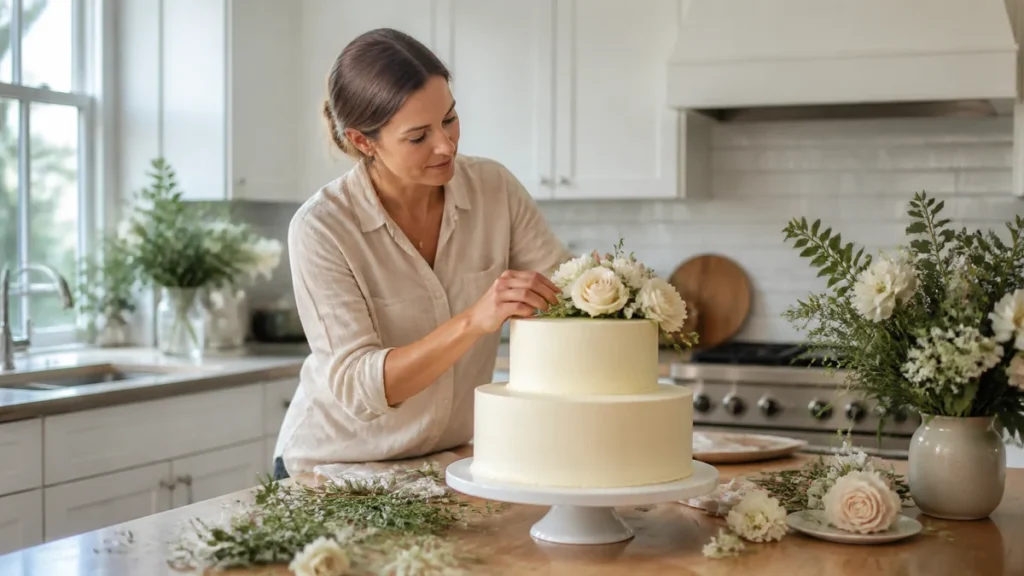
A homemade wedding cake can be a meaningful way to include a talented relative, support a small home bakery or simplify a dessert plan. In Canada, though, the answer is not simply whether the cake looks professional. The relevant questions are whether it is being sold, what ingredients and storage it needs, where the wedding is taking place, and what the venue will accept.
Start with the cake itself, then confirm the rules that apply to the baker and the event. Provincial food-business requirements differ sharply: Alberta permits the direct sale of certain low-risk home-prepared foods, while Manitoba generally prohibits preparing and serving food from a home-based business for public consumption outside a narrow exception. A venue can also set a stricter contractual requirement than the public-health baseline.
The short answer: possibly, but do not treat every homemade cake the same
A shelf-stable cake baked as a gift by a family member, a refrigerated tiered cake sold by a home business, and individually boxed cake favours are three different situations. The baker’s province, the way the cake is supplied and the food’s risk profile can all change the answer. A wedding venue may additionally control outside food through its contract, kitchen policy or insurer requirements.
The lowest-friction choice is a cake whose baker can clearly explain the ingredients, storage requirements, transport plan and applicable local approval. Do not rely on an Instagram profile, a recommendation or the fact that the cake is for a private celebration as proof that the venue will receive it or that a food business is operating appropriately.
- Treat a paid order from a home bakery as a food-business question.
- Treat a gift from a friend or relative as a separate venue and food-safety question; it is not automatically approved because no money changes hands.
- Treat cakes with fillings, whipped toppings, cream cheese, custard, mousse or fresh fruit as requiring an explicit storage conversation rather than assuming they are room-temperature desserts.
- Ask before paying a deposit or ordering non-refundable custom decorations.
Separate a family gift from a cake sold by a home business
Food-business rules discussed by provincial and local authorities focus on preparing food for sale or for public consumption. If you are purchasing a cake, ask the baker where it is prepared and which local public-health requirements apply to that business. In Ontario, for example, home-based food businesses are food premises under the provincial framework, even though businesses preparing only low-risk foods receive exemptions from some specific requirements.
A cake made as a genuine gift by someone close to you is not identical to a commercial sale. That distinction does not settle the wedding decision. The venue may still require food from an approved or inspected source, may need its kitchen team to take delivery, or may refuse responsibility for an outside cake. Get the venue’s decision in writing and do not ask catering staff to make an exception on the wedding day.
- Ask the baker whether the cake is being supplied through a registered or home-based business.
- Ask which local health authority oversees the preparation location.
- Ask the venue whether it permits outside cakes, whether a waiver or proof of insurance is needed, and who may cut and serve the cake.
- Confirm who is responsible if the cake arrives damaged, late, warm or without the agreed allergen information.
Decide whether the cake is low-risk or needs temperature control
“Homemade” is not a food-safety category. The practical dividing line is whether the finished cake needs time and temperature control for safety. Alberta describes low-risk home-prepared foods as foods that do not require refrigeration and gives baked goods as an example. Ottawa Public Health similarly lists most baked goods without custard among low-risk items, while identifying examples such as cream-filled products as a different concern.
Do not make that decision from the cake’s exterior. A fondant-covered cake may contain a perishable filling, dairy-based icing or fruit layer. Ask for the full component list: cake, soak or syrup, filling, crumb coat, exterior icing, garnish and any topper that contacts the food. If the baker says the cake must be refrigerated, plan refrigerated storage from pickup until service and do not leave it to sit through a long reception.
- Usually easier to assess: dry cakes, cookies and baked goods that do not require refrigeration.
- Ask specifically about custard, pastry cream, whipped cream, cream cheese, mousse, soft cheese, fresh-cut fruit and other refrigerated components.
- Ask whether the cake can be assembled, transported and displayed at the temperatures the baker specifies.
- If the answer is unclear, choose a different recipe, use a commercial kitchen or serve the cake as a small cutting cake with catered dessert.
Provincial rules differ, so check the baker’s location—not only the venue city
There is no single Canadian “cottage food” rule for wedding cakes. Requirements can attach to the kitchen where the cake is prepared, and municipal business or zoning rules can also apply. The following examples show why a couple should ask for the baker’s exact location and contact the relevant health authority rather than applying advice from another province.
In Alberta, the province permits the direct sale of low-risk home-prepared foods from home and at special events, subject to restrictions and safe-food handling; it also says that food must be appropriately labelled and that municipal rules may apply. Manitoba takes a much narrower position: its health authority states that preparing and serving food from a home-based business for public consumption is prohibited, except for non-potentially hazardous foods sold at specified market, craft-sale and bake-sale settings. A wedding reception is not listed in that exception.
Ontario permits home-based food businesses but applies the Food Premises Regulation and local public-health oversight. Low-risk operations may be exempt from some requirements, not from the need to operate safely or to engage with the local public-health unit. In Québec, the provincial government states that preparing meals for sale from a domestic kitchen is restaurant activity requiring a permit, and it tells operators to check municipal authorization as well. These are examples, not a substitute for advice from your local authority in every province or territory.
- Alberta: confirm that the finished product qualifies as low-risk and that any local business requirements are met.
- Manitoba: do not assume a paid home-baked wedding cake is permitted; contact Manitoba Health or use an appropriate commercial baker.
- Ontario: contact the public-health unit serving the home kitchen before placing a commercial order.
- Québec: verify permit requirements for food prepared for sale in a domestic kitchen and check municipal authorization.
- Elsewhere in Canada: contact the provincial or regional public-health authority and the municipality before booking a home-based seller.
Get written venue approval before you finalize the design
A cake that is lawful for a baker to sell can still be unacceptable under a venue agreement. Your contract may address outside food, approved suppliers, food brought by guests, plating fees, refrigeration, cake-cutting, delivery access, indemnity or liability insurance. A verbal “that should be fine” from a coordinator is not enough when the cake is large, delicate or central to the reception timeline.
Send the venue a short written description before you commit: who is making the cake, whether it is purchased or gifted, whether it requires refrigeration, when it will arrive, whether any florist will add flowers, and whether venue staff will cut it. Ask for the reply to be added to your event file. Review this alongside the broader terms in a wedding venue contract rather than treating cake approval as a casual décor detail.
- Outside-food permission and any required waiver.
- Delivery entrance, arrival window and contact person.
- Refrigerator space, temperature capability and whether staff will accept delivery.
- Cake-cutting, plating, knife, stand, forks and leftover packaging responsibilities.
- Whether fresh flowers, non-edible décor, sparklers or inedible supports are permitted.
Give guests accurate allergen information without making unsafe promises
For food sold in consumer packaging, Canadian food-labelling rules require priority allergens and gluten sources to be identified when the labelling requirements apply. A served wedding cake is not necessarily a consumer-prepackaged product, so do not assume that a federal package label is the exact legal format for your dessert table. It is still sensible to collect accurate ingredient and cross-contact information from any cake maker and give it to the caterer or person serving dessert.
Health Canada and the Canadian Food Inspection Agency identify priority allergens including milk, eggs, peanuts, tree nuts, sesame, soy, wheat and sulphites, as well as other listed priority allergens and gluten sources. A “nut-free,” “gluten-free” or “allergen-friendly” description should only be used when the baker can support it. If cross-contact is possible in the home kitchen, communicate that plainly rather than letting guests infer a guarantee.
- Request a written ingredient list for every cake flavour, filling, icing and garnish.
- Ask about separate equipment, shared mixers, shared ovens and nut-containing products in the kitchen.
- Give the serving lead a copy of the information and identify the cake clearly at service.
- Offer a separately sourced dessert when a guest’s allergy requires a level of control the cake maker cannot confirm.
- Keep the allergy conversation aligned with the dietary details collected on your RSVP list.
Plan delivery, display and leftovers as part of the cake order
For a perishable cake, the drive to the venue and the period before cutting are part of food safety—not merely logistics. Health Canada advises keeping cold food at or below 4°C and states that harmful bacteria can grow in the 4°C to 60°C temperature range. It also advises refrigerating or freezing perishable food within two hours of cooking, with extra caution in warm conditions.
Use the baker’s storage instructions as the event-specific plan. Arrange a level, secure delivery route; confirm that the cake will not wait in a sunlit lobby, a hot vehicle or an unmonitored reception room; and assign one person who can decide when it comes out of refrigeration. After serving, do not send guests home with perishable cake that has been sitting out too long simply because it is a wedding tradition.
- Confirm the delivery time against the actual cake-cutting time, not only guest arrival.
- Use refrigerated transport or insulated cold storage when the baker requires it.
- Keep the cake away from direct sun, heat sources and unstable outdoor tables.
- Use clean utensils and a designated server to reduce handling.
- For perishable leftovers, follow Health Canada’s cold-storage guidance; when in doubt, discard rather than relying on appearance or smell.
A final homemade wedding cake checklist
Complete this checklist at least several weeks before the wedding, then repeat the day-of items with the venue and cake maker. It is designed to prevent the common failure point: discovering that a beautiful cake cannot be stored, accepted or safely served once the reception is already underway.
If any answer is uncertain—especially the baker’s local approval, cake refrigeration or allergen cross-contact—change the plan while there is still time. A simpler cake from an approved baker, a refrigerated cutting cake plus catered dessert, or a non-perishable alternative can protect both the celebration and your guests.
- Identify whether the cake is a paid business order or a personal gift.
- Confirm the rules with the food authority where it is prepared.
- Obtain the venue’s written approval for outside cake and its handling terms.
- Confirm ingredient, allergen and cross-contact information.
- Document refrigeration, transport and display instructions.
- Name the delivery contact and service contact.
- Confirm cake-cutting equipment, portions and leftover plan.
- Keep copies of the order, venue approval and ingredient information with your wedding-day coordinator.
Continue planning
- wedding venue contract checklist
- wedding dietary restrictions RSVP and catering checklist
- wedding cake food-safety guide
- wedding insurance guide for Canada
- Canada wedding directory
Frequently asked questions
Can a friend make my wedding cake in Canada?
Possibly, but first obtain your venue’s written approval and assess the cake’s storage and allergen needs. If the friend is selling the cake through a home business, check the rules where it is prepared; provincial requirements are not uniform.
Are home-bakery wedding cakes allowed in Ontario?
Ontario permits home-based food businesses, with local public-health oversight. Low-risk operations can receive exemptions from some requirements, but the baker should contact the public-health unit serving the home kitchen. Your venue may still impose its own outside-food conditions.
Can a buttercream wedding cake sit out all day?
Do not decide from the word “buttercream” alone. Ask the baker whether every component requires refrigeration and follow those instructions. The filling, crumb coat, fruit, dairy content and room conditions can matter as much as the exterior icing.
Does a homemade wedding cake need an ingredient label?
Federal labelling requirements depend on whether food is prepackaged and offered for sale. Regardless of the formal labelling rule, couples should obtain a written ingredient and allergen list, share it with the dessert-service lead and avoid unsupported allergen-free claims.
Can my venue charge to cut an outside wedding cake?
It can depend on the contract and venue policy. Ask about cake-cutting, plating, refrigeration and outside-food charges before ordering. Do not assume that permission to bring a cake includes staff service, storage or leftover packaging.
Sources and verification notes
These sources were reviewed on August 10, 2026. Requirements, prices and availability can change; confirm time-sensitive details directly.
- Operating a low-risk home-based food business — Ottawa Public Health
- Low-risk home-prepared foods — Government of Alberta
- Notice to Home-Based Food Businesses — Manitoba Health
- Permis pour préparation d'aliments, restauration ou vente au détail — Gouvernement du Québec
- General Food Safety Tips — Health Canada
- Before you shop: food allergies and allergen labelling — Canadian Food Inspection Agency
Recent Ratings
-

Olivia Marie Events

Ontario » Barrie ()
-

Tamea Burd Photography
British Columbia » Vancouver (Wedding Photography)
-

the barn 1906
Ontario » Bradford (Farm Weddings)
-

M2S Photography

Alberta » Edmonton (Wedding Photography)
-

The Club at North Halton
Ontario » Halton Hills (Wedding Banquet Halls)
-

Monolith Photo
Ontario » Mississauga (Wedding Photography)
-

Rebecca Elizabeth Louise Photography
Ontario » Ottawa (Wedding Photography)
-

Aneta Elizabeth Photography
Ontario » Newmarket (Wedding Photography)
Popular Listings
-

Robin Radke Photography
476 viewsAlberta » Edmonton (Wedding Photography)
-

Jennifer Armstrong Photography
601 viewsBritish Columbia » Hornby Island (Wedding Photography)
-

Rainbow’s Roost
1,053 viewsBritish Columbia » Kamloops (Farm Weddings)
-

Sean Stealth Events
513 viewsOntario » Toronto (Wedding DJ)
-

Bearfoot Bistro
521 viewsBritish Columbia » Whistler (Restaurant Weddings)
-

Narces
364 viewsOntario » Toronto (Wedding Dresses)
-

Love Forever Studio
450 viewsOntario » Richmond Hill (Wedding Photography)
-

The Carabine Trio
548 viewsOntario » Toronto (Wedding Music)