Outdoor Wedding Noise Rules in Canada: Curfews, Permits and a Sound Plan
Published: August 11, 2026 Last reviewed: August 11, 2026.
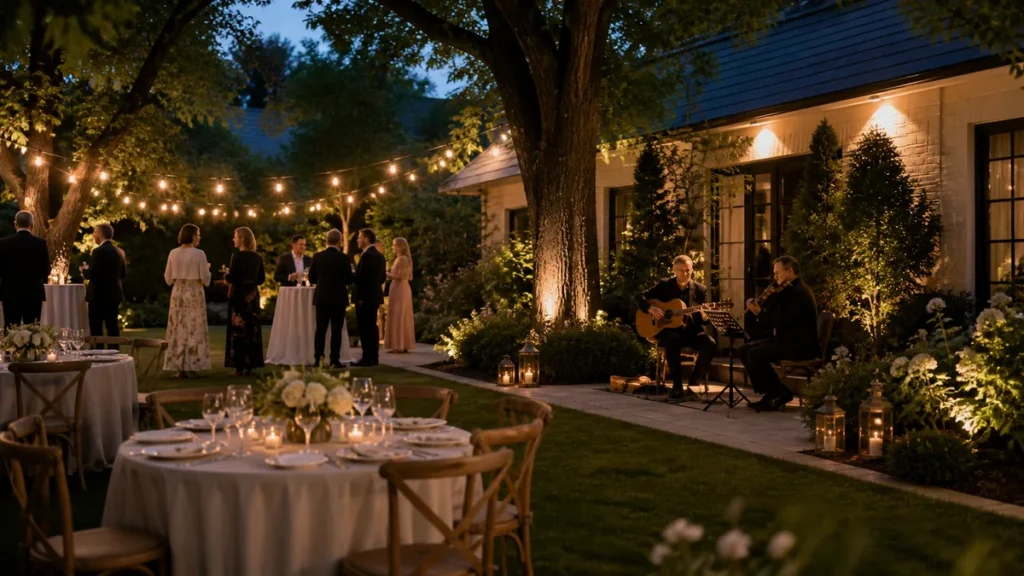
A Canadian wedding does not get one nationwide music curfew. Noise is mainly controlled by the municipality where the property sits, while the venue, park permit, rental contract and neighbourhood setting can add tighter conditions. That matters most for backyard receptions, tented celebrations, estate venues, cabins, breweries and any event using DJs, bands, speakers or microphones outdoors.
Treat sound as a site-planning issue before you promise an outdoor dance floor. A beautiful rural property can still sit near homes; a permit can have conditions; and an indoor venue may allow the party to continue while ending exterior speakers much earlier. This guide helps you ask the right questions and build a reception timeline that works in the real location.
Start with the right rule: municipal bylaw, site rule and permit condition
There is no single provincial “wedding noise permit” that applies across Canada. Begin with the city, town, regional municipality or county responsible for the ceremony or reception address. Search that municipality’s official website for its noise bylaw, noise exemption, special-event permit and park-rental rules. Do this even when the address is rural: confirm the actual municipality rather than assuming a country property has no local restriction.
Then separate the legal baseline from the rules you agreed to. A venue may set a lower indoor or outdoor sound limit, prohibit subwoofers, require doors to stay closed, limit a patio to background music, or set an earlier outdoor shutdown time. A park booking, liquor permission, tent permit or special-event approval can also impose its own conditions. Meeting the municipal rule does not override a stricter contract term.
The person holding the venue contract, property owner, event organizer and entertainment supplier should know who is responsible for compliance. Put that responsibility in writing in your planning file. For a backyard wedding, it is especially important to confirm whether the homeowner, the couple or a planner must apply and receive any approval.
- Ask for the exact outdoor amplified-sound cutoff, not just “what time does the reception end?”
- Ask whether live music, DJ sound, speeches and ceremony microphones are treated differently.
- Ask where sound is assessed: at a property line, a nearby residence or another defined point.
- Ask whether the rule changes on Sundays, statutory holidays or after a particular hour.
- Get the answer in the contract, permit or an email from the venue or municipality.
Know when a noise exemption may be necessary
A permit is not automatically required simply because guests will talk, toast or dance. The risk rises when sound is amplified, carries outdoors, runs late, includes bass-heavy music, or is near residences. Municipal rules differ sharply. In Victoria, an event with amplified sound requires a Noise Bylaw Exemption Application, and the City says an exemption may also be sought for affected private-property events that are not open to the public. In Kingsville, Ontario, the Town specifically lists backyard weddings, large family reunions and outdoor gatherings with live bands as examples of large events that may need a noise permit.
Do not build the plan around the assumption that an exemption will be issued. Edmonton’s official guidance says private functions such as wedding receptions, birthday parties and family gatherings do not qualify for its noise exemption permit. This is a useful reminder that a permit path in one municipality may not exist in another, or may be reserved for community-scale events rather than private celebrations.
A permit can also be conditional rather than a blank cheque to play louder. Toronto may require a site plan, a noise-mitigation plan, equipment orientation and notice to people within a specified radius. The City also makes clear that other approvals may still be needed. Read the issued document, not just the application page, and make its conditions part of the DJ and coordinator briefing.
- Likely lower-risk: an indoor reception with closed doors and no exterior speakers.
- Higher-risk: an outdoor dance floor, speakers aimed toward homes, a live band, subwoofers, late-night programming or a guest-heavy backyard event.
- Check first: any celebration in a municipal park, on a public waterfront, at a short-term rental, or on private property close to neighbours.
- Never advertise a late outdoor after-party until the local rule and venue policy are confirmed.
Build a sound plan before you book entertainment
Tell prospective DJs and bands the site type, guest count, exact outdoor location, nearest homes, planned music hours and any sound cap before you sign. A supplier who quotes for a ballroom may need a different setup for a lawn, tent or covered terrace. Ask what equipment they plan to bring, whether they need a subwoofer, who controls the master volume and whether they can move the dance floor indoors at a stated time.
Speaker placement is one of the most practical choices available to couples. Put speakers close to the dance floor and aim them inward, rather than trying to fill a large lawn from the far side of the property. Keep bass sources away from the nearest homes and do not place speakers on a boundary-facing deck. The City of Edmonton lists directing amplified sound away from nearby residents, limiting volume control to designated people and testing at the nearest residents’ location among its mitigation examples.
Plan separate sound moments instead of treating the whole day as one setting. Ceremony audio needs clarity for seated guests, while dinner needs low conversation-level music and dancing needs a different configuration. This lets you reduce amplification during speeches and dinner, then use the permitted outdoor dance window intentionally. If the site has an indoor room, schedule the shift before the outdoor limit rather than during the first complaint or power-down.
- Name one sound decision-maker, usually the DJ, bandleader or coordinator.
- Give that person the venue contact and the written cutoff.
- Set a sound check before guests arrive; do not use cocktail hour as the test.
- Keep a copy of permit conditions and a simple site map with speaker positions.
- Agree on a “move indoors” cue and who tells guests where to go.
Use the reception timeline to protect the party
A reception can feel generous without outdoor music continuing until the final minute. Put the activities that need the most energy inside the approved outdoor window: first dance, parent dances, any cultural performance using amplification and the first open-dance set. Move cake, a late-night snack, lounge time or a quieter send-off later if your property cannot support a long outdoor dance floor.
If you are choosing between two venues, compare usable dancing time rather than only venue closing time. One site may offer a 1 a.m. building close but require outdoor amplified sound to end much earlier; another may have an earlier overall finish but allow an enclosed dance space with good acoustics. The better fit depends on whether dancing is central to your guest experience.
A tent does not automatically make an event indoors. Ask the venue and municipality how a tent is classified for their particular rule, whether sides must be down, and whether music can continue once the surrounding area is quiet. Do not rely on what another wedding did at the property; policies, permit terms and enforcement conditions can change.
- Schedule outdoor dancing earlier if there is any uncertainty about a curfew.
- Allow 15 to 30 minutes for guests to relocate, the band to reset or the DJ to change rooms.
- Use a quieter late-night format if indoor space is unavailable: dessert, fireside conversation where permitted, board games or a hosted shuttle departure.
- Tell guests the transition in a warm, practical way: “Dancing continues inside at 10:30.”
Neighbours are part of the logistics, not an afterthought
A courteous advance notice does not replace a permit, but it can reduce surprises and give people a direct contact instead of leaving them to guess whom to call. Include the date, expected outdoor music window, a phone number for the on-site contact and a promise that amplified sound will end at the stated time. Do not promise a volume level you cannot control.
Some municipalities require neighbour notification as part of an exemption process. Victoria says affected businesses and residents must receive written notification for special-event amplified sound, with contact numbers before, during and after the event; the City may require proof it was delivered. Toronto can require distribution of a notice about an exemption to those within a 120-metre radius at least seven days before the event. Your local requirements may be different, so follow the municipality’s exact directions.
Assign someone other than a newlywed to receive and act on a concern. That person should be able to contact the DJ immediately, confirm the relevant cutoff and document what was changed. Keeping exterior doors closed, limiting patio speakers, preventing guests from congregating loudly outside after the music ends and arranging safe transport all reduce the chance that the final hour becomes the noisiest one.
- Notify neighbours only after your venue and municipality confirm the planned hours.
- Use one live phone number that will be answered during the event.
- Ask caterers, bar staff and the DJ to direct lingering guests away from residential edges of the property.
- Plan a quiet exit and pickup area, particularly where cars, taxis and shuttles pass close to homes.
Budget for compliance and avoid false economies
Do not assume a noise permit has a standard Canadian price. Municipal fees and timelines vary. Victoria lists a $50 application fee, while Toronto’s published amplified, instrument and other-sound application fees vary by application level and may be supplemented by required monitoring fees. Kingsville lists a $50 non-refundable application fee and asks that requests be made at least 30 days ahead. Verify the current fee and application window on your own municipality’s page before setting the budget.
The cost decision is broader than a permit fee. You may need a venue room change, equipment with less low-frequency output, a sound technician, acoustic treatment, an earlier outdoor program, neighbour notices, later shuttles or extra venue hours. Price the complete plan before committing to a band or an outdoor-only reception.
If the venue says “we handle permits,” ask which permit, whose name is on it, whether its approval is already in place for your date, and what happens if it is denied or conditioned. If your contract depends on late outdoor music, address that before the deposit becomes difficult to recover. Our guide to a [wedding venue contract checklist](https://canadaweddingguide.com/blog/wedding-venue-contract-checklist-canada/) can help you turn those answers into contract questions.
- Budget line: municipal application and possible monitoring fees.
- Budget line: a viable indoor or quieter backup plan.
- Contract question: who bears the cost if an approval is delayed, denied or requires a changed setup?
- Operational question: does the entertainer’s fee include moving equipment or performing indoors later?
Your final outdoor-music checklist
Complete this checklist before finalizing the reception schedule. It is designed to make the sound plan usable by the couple, venue, planner and entertainers on the wedding day.
For a wedding on municipal land, start with the park booking itself; a noise approval, if available, may be separate from the site rental. Review our [public park wedding permit guide](https://canadaweddingguide.com/blog/public-park-wedding-permit-canada/) alongside the local park office’s instructions. For a private property celebration, use the [backyard wedding permit overview](https://canadaweddingguide.com/blog/do-you-need-a-permit-for-a-backyard-wedding/) as a broader prompt, then confirm the local noise rule directly.
Sound compliance is separate from copyright licensing. A venue, DJ or band may arrange music licences, but that does not answer whether amplification is allowed at your location and time. See [wedding music licensing in Canada](https://canadaweddingguide.com/blog/wedding-music-licensing-canada/) for that distinct question. If you are serving alcohol, also plan transportation and supervision; the sound plan should never encourage guests to spill into a quiet residential street after the outdoor cutoff.
- Confirm the responsible municipality and open its current noise and event-permit pages.
- Read the venue agreement for outdoor cutoff, sound cap, door and patio rules, and indoor backup access.
- Decide whether your plan needs an exemption; apply early enough for review and possible added documents.
- Send the DJ or band the approved hours, site plan, speaker directions and one on-site contact.
- Notify neighbours if required or appropriate, using confirmed—not tentative—hours.
- Move outdoor music indoors or end it at the approved time, and keep the exit plan quiet.
Continue planning
- wedding venue contract checklist
- public park wedding permit guide
- backyard wedding permit overview
- wedding music licensing in Canada
Frequently asked questions
Do I need a noise permit for an outdoor wedding in Canada?
Maybe. The answer depends on the municipality, event address, sound level, hours, site type and whether music is amplified. Some municipalities identify backyard weddings or amplified events as permit candidates; others may not grant exemptions for private wedding receptions. Check the official local rule before committing to late outdoor music.
Can a wedding venue set an earlier music cutoff than the municipal bylaw?
Yes. Your venue contract can be stricter than the municipal baseline. Ask separately about outdoor speakers, patios, doors, bass, live bands, ceremony microphones and the time dancing must move indoors.
Does a tent let us keep playing outdoor music later?
Not necessarily. A tent is not automatically treated as a fully enclosed indoor venue. Ask the venue and municipality how their rule applies to that specific tent setup, including whether sides must be closed and whether the rule is assessed at a property line or nearby residence.
Can we rely on a noise exemption to guarantee a late-night dance party?
No. An exemption may be refused, carry conditions or be revoked when its terms are not followed. Build an indoor or quieter backup plan and make sure the reception timeline still works if outdoor amplification must end earlier.
Should we warn neighbours about our wedding?
If notification is required by an approval, follow the municipality’s instructions exactly. Even where it is not mandatory, a concise notice with confirmed date, hours and a reachable event contact can be sensible for a large private-property celebration. It does not replace compliance with the bylaw or permit.
Sources and verification notes
These sources were reviewed on August 11, 2026. Requirements, prices and availability can change; confirm time-sensitive details directly.
- Guidance for Planning Events in Toronto: Amplified Sound — City of Toronto
- Noise Exemption Permits — City of Toronto
- Noise Bylaw — City of Victoria
- Noise Exemption Permits — City of Edmonton
- Noise Permit — Town of Kingsville
Recent Ratings
-

Olivia Marie Events

Ontario » Barrie ()
-

Tamea Burd Photography
British Columbia » Vancouver (Wedding Photography)
-

the barn 1906
Ontario » Bradford (Farm Weddings)
-

M2S Photography

Alberta » Edmonton (Wedding Photography)
-
The Club at North Halton
Ontario » Halton Hills (Wedding Banquet Halls)
-

Monolith Photo
Ontario » Mississauga (Wedding Photography)
-

Rebecca Elizabeth Louise Photography
Ontario » Ottawa (Wedding Photography)
-

Aneta Elizabeth Photography
Ontario » Newmarket (Wedding Photography)
Popular Listings
-

Jennifer Armstrong Photography
601 viewsBritish Columbia » Hornby Island (Wedding Photography)
-

Fairmont Le Chateau Frontenac
542 views» Quebec (Castle Wedding)
-

Homewood Limousines
359 viewsOntario » Richmond Hill (Wedding Transportation)
-

Katie Crane Photography
496 viewsOntario » Toronto (Wedding Photography)
-

Bar U Ranch
579 viewsAlberta » Longview (Farm Weddings)
-

Paris Jewellers
476 viewsAlberta » Edmonton (Wedding Jewellery)
-

Alpine Ski Club
497 viewsOntario » Blue Mountains (Wedding Banquet Halls)
-

Henkaa
387 viewsOntario » Toronto (Cocktail Dresses)