Wedding Music Licensing in Canada: SOCAN, Re:Sound and Streaming Explained
Published: August 4, 2026 Last reviewed: August 4, 2026.
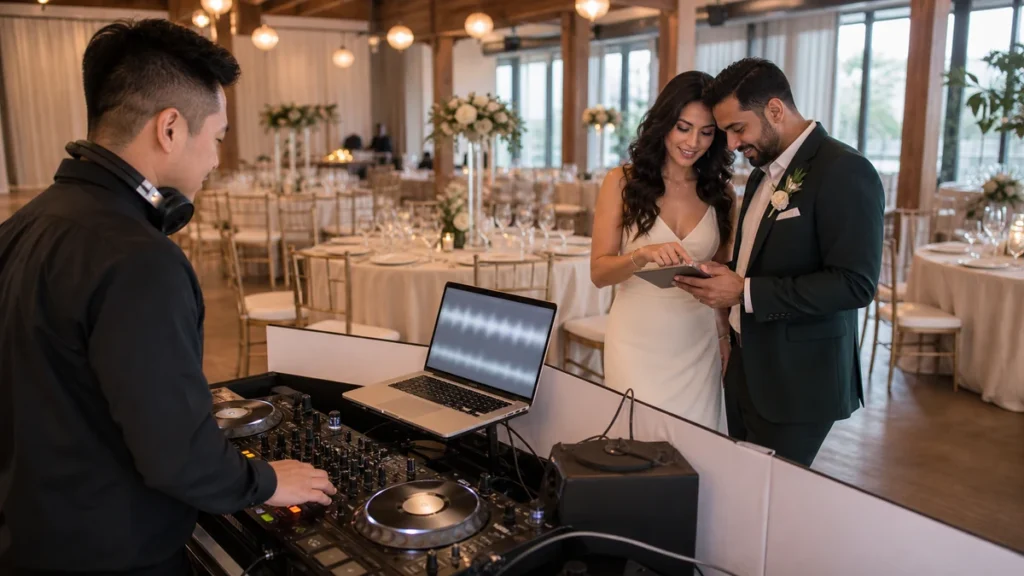
When a Canadian venue adds a “SOCAN fee” to its estimate, couples often wonder whether it is mandatory, whether Re:Sound is a second version of the same charge and why hiring a DJ does not necessarily settle the matter. The practical answer is that playing music can engage more than one right, and responsibility may rest with the venue, the event organizer or another party identified in the contract.
This guide explains the national framework as reviewed on August 3, 2026. It is designed for ordinary private weddings, not ticketed concerts or broadcasts. Copyright is federal, so the basic system applies across Canada; provincial sales taxes, contract rules and venue practices can still affect the final invoice.
Do Canadian weddings need a music licence?
A wedding reception held in a banquet hall, hotel, restaurant or similar event space will commonly require public-performance licensing when copyright-protected music is played. The relevant Re:Sound live-events tariff expressly identifies wedding receptions, while the Copyright Act gives copyright owners rights over public performances of their works.
An invitation-only guest list does not, by itself, establish that no permission is required. Begin with the venue because it may already administer the appropriate licences and pass an event-specific amount to you. If it does not, ask Entandem which party should obtain them for your particular event.
- Ask whether the venue’s music permission covers both SOCAN and Re:Sound.
- Confirm whether the quoted amount covers the ceremony, cocktail hour and reception.
- Identify in writing whether the venue, couple, planner, band or DJ will arrange payment.
- Do not pay a second supplier until you know whether another party has already included the same rights.
SOCAN, Re:Sound and Entandem serve different roles
SOCAN licensing concerns musical works—the composition and lyrics—and compensates songwriters, composers and publishers. It can apply when those works are performed live or played from recordings. Re:Sound licensing concerns public performance of eligible sound recordings and compensates performers and record labels.
Entandem is the not-for-profit licensing organization created by SOCAN and Re:Sound to provide one point of contact for many common public-performance licences. Seeing two components on an Entandem or venue invoice is therefore not automatically duplicate billing: each can represent a different layer of rights.
- DJ or recorded playlist: musical-work and sound-recording rights may both apply.
- Live cover band with no recorded music: the musical-work permission remains relevant; the recorded-music component may not apply.
- Live band using backing tracks or recorded break music: those recordings can introduce the Re:Sound component.
- Music written and performed entirely by its rights holder: ask Entandem or the rights holder to confirm what permission is still required for the setting.
Who is responsible: the venue, couple or DJ?
There is no safe universal answer based only on the vendor’s job title. Copyright Board materials describe the relevant users as event organizers or hosting venues that organize or authorize the performance. The Board also confirms that a rental venue may charge a client a portion of its own music-licensing costs.
Many established venues administer the event licence, but a rental agreement can instead make the renter responsible. A DJ may have permissions associated with the copies in a professional music library, yet that should not be treated as proof that the reception’s public performance is covered.
- Venue contract: Who obtains the event’s SOCAN and Re:Sound permissions?
- DJ contract: Does “licensed music” refer to the DJ’s music files, the venue performance or both?
- Invoice: Are the two rights listed separately, combined through Entandem or included in the rental price?
- Proof: Which party will retain the licence confirmation or paid invoice?
- Indemnity clause: Does a supplier shift responsibility for music selected by the couple?
How wedding music charges are determined in 2026
Reception tariffs have historically distinguished events by room capacity and whether dancing occurs. They are event-based rather than calculated from the number of songs. A venue may therefore ask for its authorized capacity, even when the final guest count is lower, and whether the event includes dancing.
Do not calculate a 2026 bill from an old wedding blog or an earlier certified tariff table. At this article’s review date, the Copyright Board listed relevant SOCAN reception and Re:Sound live-event tariff proceedings as under consideration. Proposed rates are not the same as approved rates. Obtain a current written quote from the venue or Entandem instead.
- Request the capacity category used in the calculation.
- State clearly whether there will be a first dance, parent dances or an open dance floor.
- Ask whether the ceremony and reception are treated as one event or separate uses.
- Confirm whether federal and provincial sales taxes are additional.
- If the amount changes, request the applicable tariff or licence name and a revised itemized invoice.
DJ, live band or personal playlist: what changes?
Hiring a DJ does not make the venue’s public-performance question disappear. The event still uses compositions and recordings, while the DJ may separately need authority for professional copies of tracks. Put responsibility for both matters in the contracts instead of relying on “the DJ handles music.”
A personal streaming subscription is not a licensing shortcut. Entandem states that a public or commercial use still requires the appropriate public-performance licences, and Spotify says its service is for personal, non-commercial use. Paying for a premium account removes advertisements; it does not expand the account into a business or public-performance service.
- Professional DJ: verify event licensing with the venue and require the DJ to warrant that their music sources and copies are authorized.
- DIY playlist: use a playback source permitted for the intended setting and confirm public-performance coverage separately.
- Live cover band: confirm SOCAN coverage, plus Re:Sound coverage for any recorded entrances, breaks or backing tracks.
- String quartet playing classical arrangements: do not assume the composition is out of copyright or that a modern arrangement is unrestricted.
- No dance floor: obtain written confirmation of the category; a planned first dance may affect how the event is reported.
- Guest song requests: require the DJ to use only music available through their authorized library.
Ceremonies, churches, backyards and outdoor weddings
A ceremony and reception can involve different venues, organizers and music sources. Ask each location what its coverage includes. A ceremony musician performing covers raises composition rights, while a recording played for the processional can also involve sound-recording rights.
The Copyright Act contains an exception for certain performances by religious institutions when they further a religious object. That wording should not be stretched into a blanket exemption for every wedding or reception held on church property. Ask the institution how it applies the exception to the ceremony and whether a rented social hall is handled separately.
For a wedding at a private home or backyard, do not assume either that a licence always applies or that an invitation-only event is automatically exempt. Whether a performance is legally public can be fact-specific. Give Entandem the location, host, guest arrangement and music format; obtain legal advice if the answer remains uncertain.
- Federal copyright rules do not change at provincial borders, including in Quebec.
- Venue contracts, applicable taxes, noise bylaws and event permits can vary by province and municipality.
- Moving outdoors does not by itself remove copyright considerations.
- A venue’s annual or blanket arrangement should be confirmed in writing rather than inferred from past weddings.
Reception licensing does not clear music for your wedding video
Permission to play a song at the event is different from permission to place that song in a video. CMRRA explains that music used in an audiovisual production requires synchronization permission, normally obtained from the music publisher or other right holder. Using a particular commercial recording can also require master-use permission from the owner of that recording.
This distinction matters for highlight films, same-day edits, livestream recordings and vertical clips delivered by a content creator. A platform accepting an upload—or temporarily leaving it online—is not evidence that the necessary rights were granted. Your videographer should identify the licensed music source and the permitted delivery, website and social-media uses.
- Who selects and licenses music for every delivered edit?
- Does the licence cover the couple’s own social accounts and the vendor’s portfolio?
- Are paid advertising, reposting and multiple versions included?
- What happens if ceremony or dance-floor music is captured audibly in the final cut?
- Will licence records remain available if a platform later questions the upload?
A contract-first checklist before paying any music charge
Resolve music licensing while reviewing the venue agreement, not during the wedding week. The most useful answer is not simply “SOCAN included”; it is a written allocation of responsibility covering the planned spaces, music formats and dancing.
If the venue cannot explain a line item, ask for the licence name and the basis of calculation. Contact Entandem before purchasing anything independently. Keep the response with the venue and entertainment contracts so the planner or day-of coordinator can show what was arranged.
- List every place music will play: ceremony, cocktail area, dining room, dance floor and outdoor spaces.
- Mark each use as live music, recorded music or both.
- Record the venue’s authorized room capacity and the planned dancing status.
- Obtain a current itemized quote for SOCAN and Re:Sound coverage.
- Confirm the responsible party and payment deadline in writing.
- Check that the DJ or band is responsible for the legality of its own music files and arrangements.
- Give the videographer separate instructions for synchronization and master-use licensing.
- Reconfirm the plan if the venue, room, entertainment format or dancing schedule changes.
Continue planning
- wedding venue contract checklist
- decide whether you need a wedding DJ
- compare wedding videography packages
- find Canadian wedding vendors
Frequently asked questions
Is the venue’s “SOCAN fee” a tax?
No. It is a copyright licensing charge, although applicable sales taxes may be added. Ask whether Re:Sound is included because it covers a different layer of rights.
Does a Spotify Premium account cover wedding playback?
No. Spotify describes its service as personal and non-commercial, and Entandem says streaming from a personal subscription does not replace public-performance licensing.
Does a first dance mean the wedding is an event with dancing?
It may affect the category even without a general dance floor. Describe all planned dances to the venue or Entandem and obtain the classification in writing.
Do we still need licensing if we hire only a live band?
Live performances of protected compositions can require SOCAN permission. Re:Sound concerns recordings, so ask separately about backing tracks, break music and recorded ceremony selections.
Can both the venue and DJ charge us for music licensing?
They may be addressing different rights, but they should not leave you paying twice for the same event permission. Request itemized descriptions and ask who holds the event licence.
Are wedding music rules different in Quebec?
The Copyright Act and collective-licensing framework are federal and apply across Canada. Contract language, taxes and venue administration may differ, so obtain documentation from the Quebec venue just as you would elsewhere.
Sources and verification notes
These sources were reviewed on 4 августа, 2026. Requirements, prices and availability can change; confirm time-sensitive details directly.
- Copyright Act, Section 3 — Department of Justice Canada
- Copyright Act, Section 32.2 — Department of Justice Canada
- Frequently Asked Questions — Copyright Board of Canada
- Under Consideration — Copyright Board of Canada
- Frequently Asked Questions — Entandem
- Tariffs: Live Events, Tariff 5.B — Re:Sound Music Licensing Company
- Get Licensed — Canadian Musical Reproduction Rights Agency
- Spotify for Public or Commercial Use — Spotify
Recent Ratings
-

Tamea Burd Photography


British Columbia » Vancouver (Wedding Photography)
-

the barn 1906
Ontario » Bradford (Farm Weddings)
-

M2S Photography
Alberta » Edmonton (Wedding Photography)
-

The Club at North Halton
Ontario » Halton Hills (Wedding Banquet Halls)
-

Monolith Photo
Ontario » Mississauga (Wedding Photography)
-

Rebecca Elizabeth Louise Photography
Ontario » Ottawa (Wedding Photography)
-

Aneta Elizabeth Photography
Ontario » Newmarket (Wedding Photography)
-

Joel Lalonde
Ontario » Ottawa (Wedding DJ)
Popular Listings
-

Heaven on 5th
(548 views)Ontario » Mono (Farm Weddings)
-

Paris Jewellers
(475 views)Alberta » Edmonton (Wedding Jewellery)
-

Sherry Smith Photography
(532 views)Ontario » Brantford (Wedding Photography)
-

Dufflet Pastries
(433 views)Ontario » Toronto (Wedding Cakes)
-

Il Barone Banquet & Conference Centre
(700 views)Quebec » Gatineau (Hotel Weddings)
-

The Carabine Trio
(542 views)Ontario » Toronto (Wedding Music)
-

Painted Rose Photography
(559 views)Ontario » Brantford (Wedding Photography)
-

Lux Music Entertainment
(280 views)British Columbia » Vancouver (Wedding Music)